What Documents Do You Need for SEIS/EIS Advance Assurance?



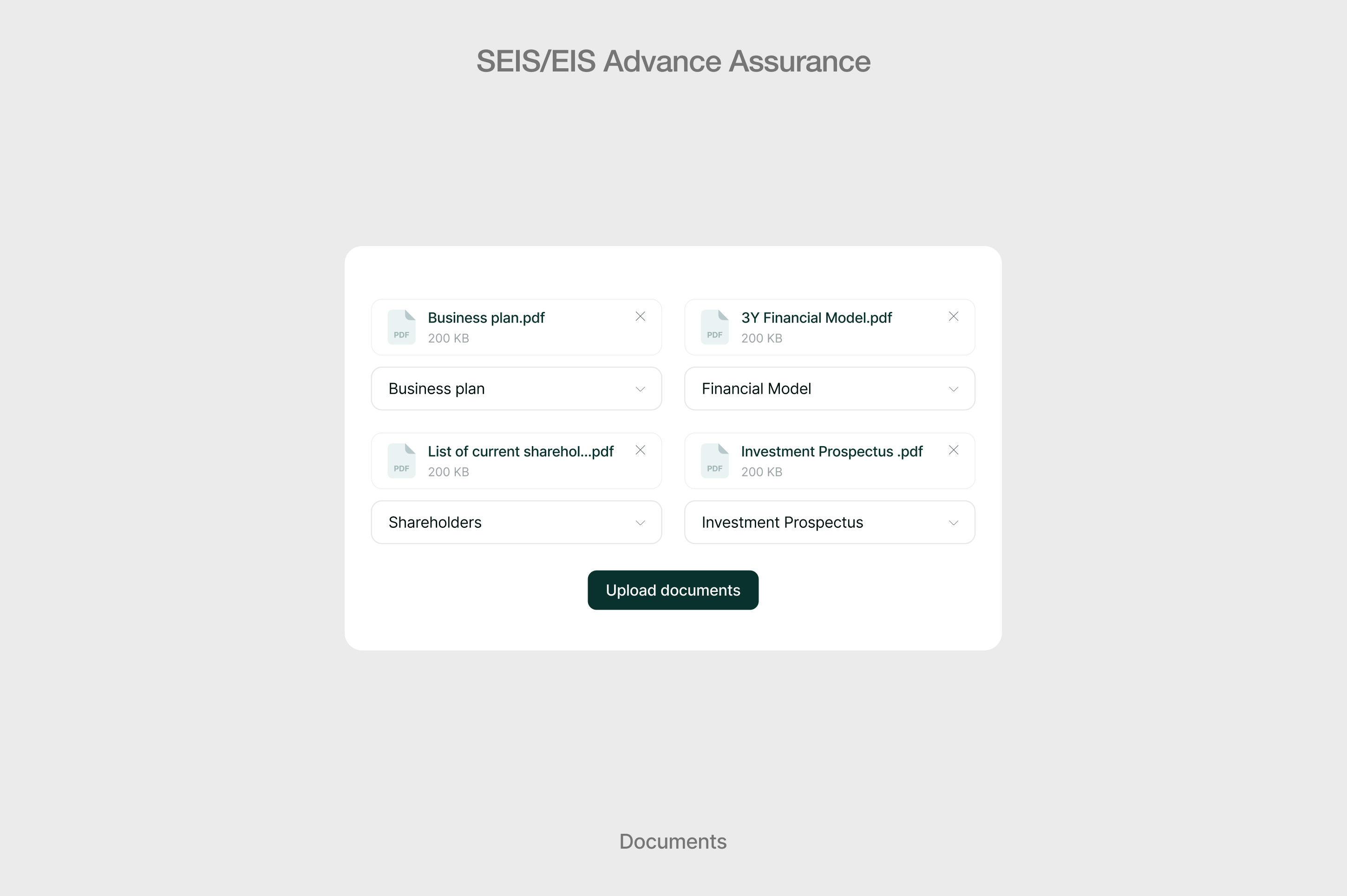
- Incomplete or inconsistent documentation causes delays. HMRC rejects about one in five applications because business plans, financial forecasts, cap tables and articles of association don’t match or are missing. Without a comprehensive package, your application stalls.
- Non‑compliant share structures and investor terms. Advance assurance requires ordinary shares without preferential rights and clear investment terms. If your articles or draft terms include redemption, guaranteed returns or multiple share classes, HMRC will raise queries.
- Lack of investor evidence and risk‑to‑capital justification. HMRC expects proof of at least one prospective investor and a statement showing that the investment carries significant risk. Failing to address risk‑to‑capital conditions leads to rejection.
Securing investment for a UK startup often starts with the Seed Enterprise Investment Scheme or the Enterprise Investment Scheme. These venture-capital relief programmes reduce investor risk through tax relief, but that requires correct risk-to-capital documentation, proper financial projections, and compliance with SEIS/EIS compliance rules under formal HMRC guidance. To unlock these benefits, you must ask HMRC for advance assurance and submit all SEIS/EIS supporting documents, including full SEIS/EIS eligibility documents.
Advance assurance is not guaranteed, especially if SEIS/EIS advance assurance documents are incomplete or misaligned with HMRC advance assurance submission checklist expectations. In the 2024–25 tax year, HMRC approved roughly 76% of EIS applications and 85% of SEIS applications, showing why precise EIS application documents, SEIS business plan requirements, and complete qualifying trade evidence matter for approval. Incomplete or poorly structured paperwork causes delays and triggers issues under the HMRC advance assurance submission checklist, especially when investment terms, company constitution, or financial projections are inconsistent.
This article provides a complete checklist of SEIS/EIS advance assurance documents, explains why HMRC requires each item, and shows you how to avoid common mistakes.
Overview of SEIS/EIS Advance Assurance Documentation
The Seed Enterprise Investment Scheme supports early-stage companies and places emphasis on SEIS business plan requirements, qualifying trade evidence, and investor-ready SEIS/EIS supporting documents. To qualify, the business must be UK‑incorporated, trading for less than three years, have gross assets of no more than £350k and fewer than 25 employees. Companies can raise up to £250,000 through SEIS. The Enterprise Investment Scheme targets slightly more mature startups. Qualifying companies can trade for up to seven years (ten for knowledge‑intensive companies), have up to £15 m in gross assets and fewer than 250 employees.
Both programmes require valid qualifying trade evidence and SEIS/EIS investor terms confirming that only ordinary, non-preferential shares are issued in line with Articles of Association requirements.
Advance assurance documentation is similar across both schemes, but there are differences in the level of detail. Broadly, you need:
- A business plan and financial forecasts showing growth potential and compliance with the risk‑to‑capital condition.
- An up‑to‑date cap table and register of members showing existing shareholders and share classes.
- Your articles of association and company constitution prove that shares are ordinary and without preferential rights.
- Clear investment terms detailing share price, share count, and SEIS/EIS investor terms are required to meet HMRC guidance and provide transparent funding structure information.
- Evidence of your qualifying trade, including market analysis, contracts or product development.
- A risk‑to‑capital statement demonstrating that funds will be used to grow and develop the business and that investors risk losing more than they gain.
- Details of prospective investors, including names, addresses and the amount they intend to invest.
The following sections provide a detailed checklist for SEIS and EIS and explain how to prepare each document correctly.
SEIS Advance Assurance: Required Documents
SEIS documentation must show that your early‑stage venture meets the strict criteria and that the investment is genuinely at risk. Below you will find a comprehensive list of documents and how to prepare them.
1. Business Plan (Mandatory)
HMRC expects a clear and concise SEIS business plan. It should describe your qualifying trade, target market, revenue model and how SEIS funds will be used to grow the business. According to HMRC guidance, applications must include a business plan and financial forecasts. Law firm guidance suggests writing the plan in plain English, explaining the gap in the market, how you operate day to day, and including competitor analysis. For SEIS, the plan need not be lengthy; a concise document (10–15 pages) is enough if it covers the essentials:
- Qualifying trade description: Explain what you make or do and why it is a qualifying trade. Avoid HMRC‑excluded activities such as property development or financial services.
- Market analysis: Provide data about your target market, customers and competitors. Show that there is room for growth.
- Revenue model: Describe how you will make money. Outline pricing, sales channels and expected margins.
- Use of funds: Specify how SEIS money will be spent (e.g., product development, hiring, marketing) and ensure spending occurs within three years, as required.
- Execution plan: Provide a timeline of milestones and key hires.
Why HMRC needs it: the business plan helps assess whether you are a genuine trading company and whether the investment will be used for growth rather than tax avoidance.
2. Financial Forecasts (Mandatory)
You must include financial forecasts. HMRC guidance specifies that you need forecasts showing revenue, costs and cash flow. Fintech investors also expect at least a three‑year model for SEIS. Your forecasts should:
- Show assumptions: Clearly state sales growth rates, cost of goods, hiring plans and marketing spend.
- Align with your business plan: Numbers must mirror the narrative. Discrepancies between the plan and forecast are one of the most common causes of HMRC queries.
- Provide monthly granularity: For the first year, monthly breakdowns help HMRC judge viability. For years two and three, quarterly or annual figures may suffice.
- Explain funding gaps: If you will need additional funding after the SEIS round, note this and explain how you will cover it.
3. Cap Table (Mandatory)
An up‑to‑date cap table or register of members shows who owns the company and how new shares will dilute existing holders. HMRC requires a copy of the register of members and details of existing shareholders when you apply. Your cap table should list:
- Shareholder names and classes: Show ordinary shares, preference shares (if any) and option holders.
- Number of shares and percentage ownership: Provide both existing holdings and the projected post‑investment breakdown.
- Options and warrants: Include outstanding options and convertible securities so HMRC can verify that new investors will hold ordinary shares.
Ensure that shares offered to SEIS investors will be ordinary shares without preferential rights or redemption clauses. A clear cap table helps HMRC confirm compliance with the share requirements and prevents dilution‑related issues later.
4. Articles of Association (Mandatory)
Your articles of association and shareholder agreements set out how the company is governed. HMRC reviews these documents to ensure that shares meet the scheme’s requirements. Ordinary shares must be fully paid in cash and must not carry preferential rights to dividends, assets on winding up or redemption rights. If your articles include preference shares, anti‑dilution rights or guaranteed returns, you will need to amend them before submitting your application.
Common pitfalls include:
- Redemption clauses: Any right to buy back shares will fail the “ordinary share” test.
- Dividend preferences or ratchets: Shares must not provide guaranteed or cumulative dividends.
- Liquidation preferences: A right to priority over ordinary shareholders on winding up is disallowed.
It is advisable to have a solicitor review your articles. If you intend to adopt new articles before the fundraising (e.g., to include investor protections), submit both the existing and proposed documents to HMRC and explain why the changes are necessary.
5. Details of Proposed Investment Terms (Mandatory)
HMRC asks for the draft investment terms so they can check that investors will receive ordinary shares. Your submission should specify:
- Share price and number of shares to be issued under SEIS.
- Pre‑money valuation of the company.
- Investor rights. Confirm that the shares carry no preferential rights. If there is a shareholder agreement, summarise key terms such as tag‑along, drag‑along or voting rights.
- Any side agreements or warranties.
You should also explain whether existing shareholders will participate. Provide a draft subscription agreement if available. According to HMRC guidance, you must also provide details of any other agreements between the company and shareholders or venture capital trusts.
6. Description of Qualifying Trade
SEIS funding can only be used for qualifying trades. Excluded activities include financial services, property development, leasing, legal services, energy generation and nursing homes. To show that your business is eligible, include evidence such as:
- Market research reports showing demand.
- Letters of intent or contracts from customers.
- Product designs, wireframes or prototypes to prove you are developing a genuine product.
- Registration documents for patents or intellectual property.
HMRC will use this evidence to determine if you carry on a qualifying trade and whether the business has realistic prospects of commercial success.
7. Risk‑to‑Capital Statement
The risk‑to‑capital condition is a principles‑based test introduced in 2018. It requires that
- the company’s objectives are to grow and develop over the long term,
- and the investment carries a significant risk that the investor will lose more capital than they stand to gain (including tax reliefs). In your statement:
- Explain your commercial objectives: Show how SEIS funding will be used to develop new products, hire staff or expand into new markets.
- Demonstrate genuine risk: Highlight uncertainties, competitive pressures or regulatory hurdles. Avoid language suggesting the investment is “safe.”
- Show alignment with investor risk appetite: Clarify that investors understand the risks and that there are no arrangements designed to protect their capital.
Providing a clear risk‑to‑capital statement reassures HMRC that you are not engaged in a tax avoidance scheme and helps prevent rejection.
8. Constitution Documents (If Applicable)
In addition to the mandatory documents, you may need to submit other constitutional papers:
- Shareholders’ agreements: Summarise the rights and obligations of shareholders.
- Board resolutions relating to fundraising: Provide minutes authorising the share issue.
- Director statements: If any directors are also investors, include statements confirming they do not control more than 30% of the company.
These documents help HMRC verify that the transaction is properly authorised and that directors are not receiving preferential treatment.
EIS Advance Assurance: Required Documents
The Enterprise Investment Scheme has the same core documentation requirements as SEIS but demands more detail due to larger funding sizes and later‑stage expectations. The following items build upon the SEIS requirements.
1. Updated Business Plan
For EIS, your business plan should be more detailed. Because EIS companies can raise up to £5 million per year and £12 million in total (higher for knowledge‑intensive companies), HMRC expects robust revenue modelling and execution plans. You should:
- Extend the planning horizon to three to five years.
- Provide a detailed go‑to‑market strategy, including marketing channels and partnerships.
- Demonstrate how EIS funds will accelerate growth beyond the initial SEIS stage.
- Explain any previous SEIS funding and how those funds were used.
2. Updated Financial Model
EIS investors expect multi‑year financial forecasts. These should include:
- Revenue breakdowns by product line or market.
- Gross margin projections and cost of sales.
- Operating expense schedules, including hiring, rent, and technology spend.
- An investment schedule that shows when funds will be deployed.
Your forecasts must align with the risk‑to‑capital statement. For EIS, the spend window is shorter; funds must be used within two years, so your model should illustrate how you will deploy capital quickly.
3. Use of EIS Funds
Because EIS rounds are larger, HMRC wants a clear breakdown of how the funds will be used. Acceptable uses include:
- Commercialisation and scale‑up: Hiring sales teams, expanding production, or entering new markets.
- Research and development: Developing new products or technology.
- Operational scaling: Investing in systems, regulatory compliance or working capital.
You must avoid non‑qualifying expenditures such as repaying existing debt or acquiring shares in another company. Clearly allocate funds to qualifying activities in your plan.
4. Updated Cap Table With SEIS Already Reflected
If you have already raised under SEIS, your EIS cap table must show issued SEIS shares. HMRC will check that SEIS shares were issued first and dated before any EIS shares. Dual rounds require careful sequencing: SEIS shares must be issued and dated before EIS shares. Present your cap table in two columns (pre‑ and post‑EIS) to illustrate dilution and to confirm that no prohibited share rights remain.
5. Subsidiary Information (If Relevant)
Group structures can affect EIS eligibility. You must provide details of any subsidiaries, including:
- Ownership percentages: Show that the parent owns at least 90% of subsidiary shares if the funds will be used in that entity.
- Trading activities and assets: Demonstrate that each subsidiary also carries on a qualifying trade.
- Group balance sheet: Provide consolidated figures to verify that the group meets the £15 million asset limit and 250‑employee cap.
Shared Documents Required for Both SEIS and EIS
Certain documents are essential regardless of the scheme. Preparing them thoroughly ensures consistency across your submission.
1. Pitch Deck or Investor Presentation
HMRC expects consistency between your pitch deck and business plan. The deck is not mandatory but is recommended because it helps HMRC and investors understand your proposition quickly. Your deck should summarise the business problem, solution, market size, business model, traction and team. Make sure the numbers match your forecasts and that you avoid language implying low risk.
2. Supporting Evidence of Planned Activity
You can strengthen your application by including supporting documents such as:
- Wireframes or product designs that demonstrate progress towards a viable product.
- Contracts or letters of intent with customers, suppliers or partners.
- Grant applications or awards that validate your technology.
This evidence shows HMRC that you are more than a paper company and helps satisfy the risk‑to‑capital test.
3. Company Tax and Registration Information
Provide basic company information:
- Corporation tax number: HMRC uses this to verify your tax status.
- Company number and confirmation statement: Download these from Companies House.
- SIC codes: Choose codes that align with your qualifying trade and avoid codes associated with excluded activities.
- Director names and addresses.
4. Investment Pipeline Evidence (Optional but Recommended)
Although HMRC requires at least one named investor, you can include further evidence of investor interest. Provide emails from prospective investors, term sheets or soft commitments. This demonstrates that the round is realistic and reduces suspicion of speculative applications.
Common Documentation Mistakes that Delay SEIS/EIS Approval
Even well‑prepared founders make mistakes that cause HMRC queries. Awareness of these pitfalls helps you avoid them.
Inconsistent Business Plan and Financials
Discrepancies between narrative and numbers raise compliance flags. For example, if the business plan talks about aggressive marketing but the forecast allocates little marketing spend, HMRC may question your credibility. Always cross‑check figures across documents.
Non‑Compliant Share Rights
Issuing shares with redemption rights, guaranteed dividends, or liquidation preferences will disqualify the shares. Ensure your articles and shareholder agreements reflect only ordinary shares. If you intend to issue preference shares to non‑EIS investors, create separate share classes and show that EIS investors receive ordinary shares.
Missing Risk‑to‑Capital Explanation
HMRC is particularly sensitive to the risk‑to‑capital condition. Some founders provide generic statements instead of specific risks. Highlight sector uncertainties, competition and regulatory hurdles. Explain how funds will drive growth and why investors could lose money. Do not over‑emphasise safety; HMRC will treat that as evidence that the investment is structured to protect capital, which is disallowed.
Incorrect or Outdated Cap Table
An inconsistent cap table is a frequent cause of rejection. Ensure your register of members matches Companies House filings and includes any option grants or convertible notes. If you have conducted a small friends‑and‑family round, update the cap table accordingly. For dual rounds, clearly separate SEIS and EIS allocations.
Draft Investment Terms Without Key Details
HMRC will not accept placeholders. Provide actual share price, valuation and investor rights. If the terms change later, submit updated documents before issuing shares. Failure to provide full terms can lead HMRC to view the application as speculative.
How to Prepare a Complete SEIS/EIS Advance Assurance Pack
Step‑by‑Step Document Preparation Checklist
- Map eligibility: Confirm your company meets SEIS/EIS criteria (age, assets, employees, independent and qualifying trade). Use government checklists and internal guides.
- Draft the business plan: Write a concise plan covering trade, market, revenue, fund use and growth. Ensure plain language and clear structure.
- Build financial forecasts: Prepare 3‑year projections with assumptions and monthly breakdowns. Align them with the business plan.
- Update the cap table: Capture all shareholders, share classes, options and convertible notes. Prepare pre‑ and post‑investment versions.
- Review articles and shareholder agreements: Remove preferential rights and redemption clauses. Prepare proposed articles if changes are needed.
- Draft investment terms: Set share price, number of shares and investor rights. Ensure ordinary share status.
- Gather supporting evidence: Collect market research, contracts, prototypes and investor letters.
- Write the risk‑to‑capital statement: Demonstrate growth objectives and genuine risk.
- Prepare tax and registration information: Include company number, corporation tax number and SIC codes.
- Compile investor details: Provide names, addresses and intended investment amounts.
- Package and cross‑check: Ensure consistency across all documents. Double‑check numbers, names and dates.
- Submit via HMRC portal: Upload your documents through the HMRC online form and attach the completed SEIS or EIS checklist.
How to Ensure Consistency Across All Materials
Consistency prevents HMRC queries. Use the following approaches:
- Single source of truth: Maintain one spreadsheet with all figures (revenue, costs, share counts) and reference it in the business plan, forecast, cap table and deck.
- Version control: Name documents clearly and keep track of revisions. Avoid sending draft and final versions simultaneously.
- Cross‑team review: Have different team members review each document against the checklist.
- Legal and tax review: Use a solicitor or accountant to check compliance with share requirements and tax rules.
Recommended Order for Assembling the Pack
- Prepare the business plan and risk‑to‑capital statement. These form the narrative foundation.
- Build the financial model. Iterate until numbers align with the plan.
- Update the cap table and articles. Implement any changes to the share structure.
- Draft the investment terms and gather investor letters.
- Compile supporting evidence and tax information.
- Review everything for consistency and completeness. Use HMRC’s SEIS or EIS checklist as a final audit.
How Undo Capital Simplifies SEIS/EIS Documentation
Preparing and maintaining SEIS/EIS documentation is time‑consuming and complex. Undo Capital offers an automated platform to streamline this process. The platform:
- Automates document collection and generation: Smart forms gather information and produce a complete SEIS/EIS advanced assurance pack, including business plans, forecasts and cap tables.
- Validates share structure: Built‑in checks ensure your shares are ordinary and comply with HMRC rules. The system flags any preferential rights for correction.
- Checks eligibility: Undo Capital guides you through age, asset and employee limits, and alerts you if your company enters a non‑qualifying trade.
- Prepares reliable submission packages: It assembles documents into HMRC’s preferred format and helps you submit via the online portal.
- Reduces questions and delays: By ensuring consistency and completeness, the platform lowers the risk of HMRC queries, speeding up approval.
Undo Capital also manages post‑investment compliance by generating SEIS1/EIS1 forms and issuing certificates. If you want to see how it works, visit Undo Capital’s SEIS/EIS Advance Assurance page.
FAQs
What documents does HMRC require for SEIS advance assurance?

HMRC asks for a detailed business plan, financial forecasts, an up‑to‑date cap table, your articles of association, draft investment terms, evidence of a qualifying trade, a risk‑to‑capital statement and details of at least one prospective investor. You must also include a copy of your latest accounts, the register of members and any shareholder agreements. Preparing these documents carefully improves your chances of approval.
What documents are needed for EIS advance assurance?
EIS requires all the SEIS documents plus more detailed business plans and multi‑year financial models. You must provide updated cap tables reflecting SEIS shares, clearly explain how EIS funds will be used to scale the business, and include information about any subsidiaries. Because EIS rounds are larger, HMRC scrutinises your trade, use of funds and share structure more closely.
Do I need a business plan for SEIS/EIS?
Yes. The business plan is mandatory. HMRC uses it to determine if your company is a genuine trading business and to assess your risk‑to‑capital compliance. The plan should describe the market, revenue model, use of funds and growth strategy. Avoid jargon and ensure the plan aligns with your financial forecasts.
Is a pitch deck mandatory for advance assurance?
HMRC does not explicitly require a pitch deck, but including one helps. It summarises your business plan and provides a visual overview for HMRC and investors. Ensure the deck is consistent with your business plan and that numbers match across documents.
Why does HMRC ask for detailed financials?
Financial forecasts allow HMRC to assess viability and risk. They verify that your business has growth potential and that SEIS/EIS funds will be used for qualifying activities. Detailed forecasts also show whether the investment might preserve rather than risk capital, which would contravene the risk‑to‑capital condition.
References
https://www.gov.uk/hmrc-internal-manuals/venture-capital-schemes-manual/vcm12020
https://www.gov.uk/hmrc-internal-manuals/venture-capital-schemes-manual/vcm8530
https://www.gov.uk/guidance/venture-capital-schemes-apply-for-advance-assurance
https://www.gov.uk/hmrc-internal-manuals/venture-capital-schemes-manual/vcm11080
https://www.gov.uk/hmrc-internal-manuals/venture-capital-schemes-manual/vcm55170
Disclosure Notice: This communication is issued by Undo Capital Limited (“Undo Capital”) and is provided strictly for informational purposes only. It contains general information and should not be relied upon as accounting, business, financial, investment, legal, tax, or other professional advice. Undo Capital is not regulated by the Financial Conduct Authority (FCA) and does not provide investment, financial, or tax advice. Our services are designed to assist startups and businesses with company formation, legal agreements, and funding-related documentation. Nothing in this communication constitutes, or should be construed as, a recommendation, offer, or solicitation to purchase or sell any security or financial instrument.
Participation in startups and early-stage enterprises involves significant risk. Such investments may be illiquid, may not generate dividends, may be subject to dilution, and may result in the total loss of invested capital. Any decisions or actions that may affect your business or personal interests should be taken only after seeking advice from suitably qualified professional advisors, and should form part of a balanced and diversified portfolio. This communication may contain links to third-party websites. The inclusion of such links does not imply endorsement, approval, investigation, or verification by Undo Capital. We accept no responsibility or liability for the content, accuracy, or use of information contained on any third-party websites.
Latest articles
SEIS and EIS Tax Relief Calculator

Founders Agreement Template UK: What Every Co-Founder Should Include