How to Build an Investor‑Ready Data Room for UK Funding Rounds?



- A well‑structured investor data room UK speeds up due diligence and signals professionalism. UK investors expect one before they commit, so prepare early and keep it current.
- A complete investor due diligence checklist spans corporate, cap table, SEIS/EIS, legal, financial, product/technical, HR, IP, and market documents. Missing or inconsistent records delay your UK funding round data room.
- Tools like Undo Capital automate cap table snapshots, SEIS/EIS paperwork and secure document storage, making it easier for data room UK startups to stay compliant.
Raising capital isn’t derailed by weak pitches; it’s derailed by missing documents. The moment you enter a UK funding round, investors expect a complete investor data room UK that proves you are organised, compliant, and ready for due diligence. When a startup data room guide is absent or chaotic, rounds stall, valuations drop, and deals die.
The pain is real: investors reject deals when filings don’t match, SEIS/EIS eligibility isn’t proven, or cap tables lack clarity. Recent UK guidance shows that structured investor documentation signals discipline and transparency, while gaps, like missing SH01 filings or unclear IP ownership, create red flags. And cap table clarity is a priority for UK investors, because it affects control, dilution and exit potential.
This article cuts through the noise. You’ll learn how to build a data room UK startups can rely on, structure it for speed, align with SEIS/EIS rules, and meet the investor due diligence checklist with confidence. We’ll highlight pitfalls, real-world costs of errors, and show how Undo Capital document automation reduces friction so you can move from pitch to term sheet faster.
What is an Investor Data Room (UK Context)?
An investor data room is a secure, structured repository of documents that allows investors to evaluate your company’s risk, compliance and growth potential. In the UK, it’s typically a virtual folder hosted on a secure platform. Here’s why it matters.
Purpose of a Data Room in UK Fundraising
Investors use data rooms for due diligence, risk assessment and compliance verification. A centralised data room saves time for both sides, reduces friction and signals professionalism. Investor guidance emphasises that a well‑prepared data room accelerates due diligence and reduces investor friction.
It allows investors to confirm that your corporate filings, financial statements and legal agreements match what’s stated in your pitch and helps them assess whether your business meets SEIS/EIS risk‑to‑capital requirements. The data room is also the basis for verifying compliance with UK law, including data protection (GDPR), Companies House filings and SEIS/EIS rules.
Why Do UK Investors Require a Formal Data Room?
UK investors expect a formal data room because it demonstrates transparency and legal compliance. It shows that your company has orderly corporate governance, accurate cap table records and complete legal agreements. Government guidance notes that investors look for a clean, organised structure with clearly indexed folders so they can find materials easily.
They expect current and accurate information; outdated or inconsistent records, such as missing share allotment filings (form SH01) or gaps in IP ownership, raise concerns. For example, Companies House requires that any share allotment be reported via form SH01 within one month of the allotment. Failure to file on time is a statutory offence. Having these filings in your data room proves compliance.
Types of Data Rooms (Virtual, Deal Platform, Secure Folders)
There are three main approaches to data rooms:
- Virtual data rooms (VDRs) – purpose‑built platforms offering encryption, role‑based permissions and audit trails. They often include indexing and Q&A functions.
- Deal platforms – integrated systems that combine data rooms with cap table document automation, like Undo Capital. These allow real‑time updates and seamless SEIS/EIS document generation.
- Secure folders (e.g., Google Drive or Dropbox) – simple to set up but lacking in security, version control and Q&A features. Professional guidance recommends professionally hosted data rooms over free solutions to ensure confidentiality and security.
When choosing a platform, ensure it offers encryption, two‑factor authentication and activity tracking. For high‑risk or competitive transactions, consider creating a “clean room” with restricted access for confidential information.
How to Structure a UK Investor Data Room: Folder Architecture
An organised folder architecture is critical. UK government guidance recommends presenting a clean, organised structure with clearly indexed folders.
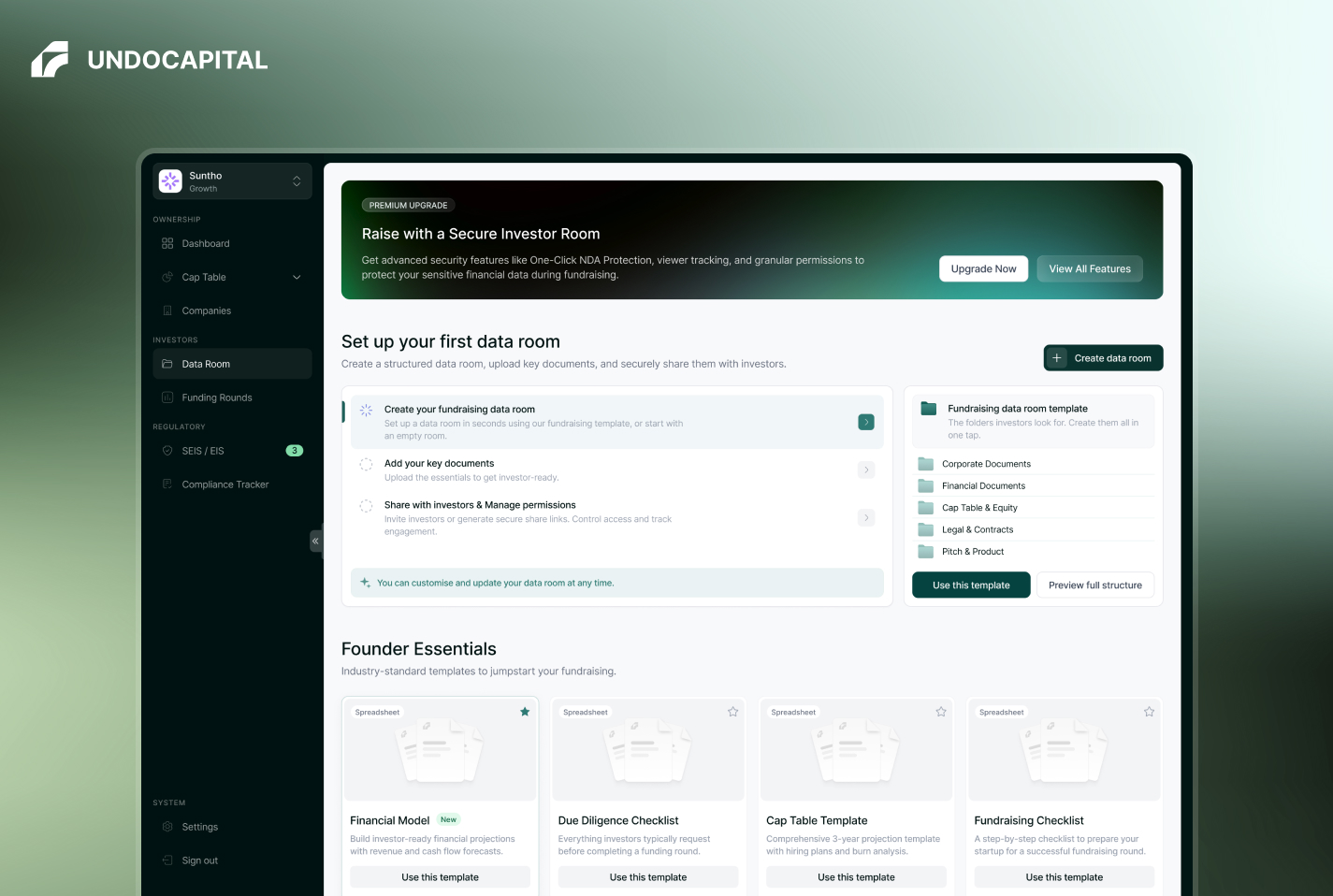
Corporate Documents
These files establish your company’s identity and governance:
- Certificate of incorporation – proof that the company exists.
- Articles of Association – the constitution of the company.
- Shareholder resolutions and board minutes – record major decisions.
- Form SH01 filings and confirmation statements – evidence of share allotments and annual updates to Companies House. Filing an SH01 within one month of allotting shares is a statutory requirement.
- Companies House filings – including amendments to the Articles, and any charges or mortgages.
These documents show investors that your company is legally formed, properly governed and compliant with corporate law. Always ensure that your Companies House record matches the contents of your data room. Any discrepancies can raise red flags during due diligence.
Cap Table and Shareholder Documentation
An accurate cap table is crucial. The British Business Bank notes that although there’s no legal obligation to maintain one, a cap table is vital for attracting investment and helps investors assess ownership during due diligence. Include:
- Fully updated cap table – listing all shareholders, share classes, option holders and dilution effects.
- Option pool documentation – option scheme rules, grant letters and vesting schedules.
- Share certificates – copies of all certificates issued to shareholders.
- Agreements – such as Advance Subscription Agreements (ASAs), simple agreements for future equity (SAFEs), and subscription agreements.
Accurate cap tables prevent misunderstandings and legal disputes. If your company has issued SEIS or EIS shares on different dates, ensure the SH01 form reflects both start and end dates for the allotment period.
Keep your cap table investor-ready. Track shareholders, share issuances, option pools and funding rounds in Undo Capital to reduce manual errors and maintain accurate equity records as your company grows.
SEIS/EIS Documentation
Tax‑efficient investment schemes are a key part of UK fundraising. Investors will ask for the following:
- Advance assurance letter – issued by HMRC confirming that your share issue is likely to qualify for SEIS or EIS.
- Eligibility documentation – to show that your company meets SEIS/EIS criteria. HMRC guidance states that under SEIS, a company can raise up to £250,000 and must be established in the UK, not trading on a recognised stock exchange, and have fewer than 25 employees.
- SEIS1/EIS1 compliance statements – forms submitted to HMRC after shares are issued, confirming that the issue meets the scheme requirements. After approval, HMRC sends SEIS2/EIS2 authorisation letters and compliance certificates (SEIS3/EIS3), which you must provide to investors so they can claim tax relief.
- Risk‑to‑capital statement – explaining how your company intends to grow and develop, and showing that the investment carries a significant risk of loss. HMRC guidance requires that SEIS/EIS investments meet this condition: the company must have a long‑term objective to grow, and there must be a risk that the investor could lose more than the return.
- Corporate filings supporting eligibility – such as updated Articles, investor agreements and any correspondence with HMRC.
For a step‑by‑step guide on obtaining advance assurance and meeting eligibility criteria, see our advance assurance guide and SEIS/EIS eligibility criteria page.
Keep your SEIS/EIS documents organised. Manage Advance Assurance, compliance records and investor documentation alongside your cap table and data room in Undo Capital.
Legal Agreements
Investors expect to review all material legal contracts. Include:
- Shareholders’ agreement – sets out shareholders’ rights and obligations.
- Founders’ agreement – clarifies roles, vesting and ownership among founders.
- Intellectual property (IP) assignment agreements – proof that all IP created by founders and contractors is owned by the company. Investors will verify that trademarks, patents and domain names are registered in the company’s name.
- Non‑disclosure agreements (NDAs) – for employees, contractors and third parties.
- Customer, supplier and vendor contracts – material agreements that could affect revenue.
- Loan agreements, convertible notes or debt facilities – including any security documents.
Financial Documents
Financial transparency is essential. Include:
- Historical profit and loss (P&L) statements, balance sheets and cash flow statements for at least the past two to three years.
- Management accounts – monthly or quarterly summaries.
- Cash flow forecast – typically covering at least 12 months.
- Audited financial statements – if available.
- Financial model – a UK‑compliant model supporting your valuation and projections (e.g., revenue growth assumptions, cost breakdowns). Investors use this to test scenarios.
Ensure that financial documents reconcile with your accounts filed at Companies House. Founders should organise up‑to‑date accounts and management information before due diligence.
Product & Technical Documentation
Your product strategy and technology stack must be transparent. Include:
- Architecture diagrams – showing how your product and infrastructure fit together.
- Software documentation – source code summaries, development processes and version control history.
- Security and data processing policies – descriptions of security measures and evidence of compliance with GDPR. UK GDPR guidance states that data controllers must ensure processors have robust security measures and demonstrate accountability. Data sharing agreements should define the purpose of shared data, security protocols and remedies.
- Data protection impact assessments – if relevant.
- Product roadmap – showing upcoming features and milestones.
HR & Employment Documentation
Human capital is often a company’s largest expense. HR due diligence helps investors understand staff costs and liabilities. The ICAEW’s HR due diligence guideline notes that typical documentation includes employee handbooks, benefit policy documents, historical cost information, collective bargaining agreements, incentive plan documentation, director service agreements and sample employment contracts. In your data room, include:
- Employment contracts (UK format) – with salary, bonus, start date and job title.
- Consultancy agreements – for contractors.
- Employee handbook and policies – covering benefits, equal opportunities, disciplinary procedures and anti‑bribery statements.
- Option schemes – share option plans, EMI scheme documents and vesting schedules.
- Whistleblower and anti‑bribery policies – required for many regulated sectors.
- GDPR compliance documents – privacy notices, data protection policies and subject access request procedures. The Information Commissioner’s Office (ICO) stresses that transparency about how you use personal data is a key requirement of the Data Protection Act and GDPR. Employers should provide accessible privacy notices and incorporate data protection statements into contracts or handbooks.
Make sure sensitive data is redacted before sharing. Orrick’s guidance suggests that a target should remove personal data that does not need to be shared and consider AI tools that automatically redact personal data.
IP Ownership and Protection
Intellectual property is often your most valuable asset. Investors will check that the company owns its IP and that it’s protected. Include:
- IP assignments – agreements transferring IP rights from founders, employees and contractors to the company.
- Patent and trademark filings – certificates and pending applications.
- Licensing agreements – for any third‑party IP incorporated into your product.
- Domain name registrations – proof of ownership.
Commercial and Market Documents
Investors need to understand your market position and traction. Include:
- Customer pipeline and revenue metrics – such as monthly recurring revenue (MRR), annual recurring revenue (ARR) and churn.
- Market research – TAM/SAM/SOM analyses, competitor maps and growth forecasts.
- Key performance indicators (KPIs) – dashboard or summary sheet.
- Marketing and sales plans – outlining channels, budgets and conversion metrics.
Folder Architecture Summary Table
Below is a summary of the recommended folder structure. Each entry uses UK spelling and short phrases to respect your reader’s time.
SEIS/EIS Documents Investors Expect in the Data Room
SEIS (Seed Enterprise Investment Scheme) and EIS (Enterprise Investment Scheme) offer tax reliefs that make early‑stage investments more attractive. UK investors often insist that your UK due diligence data room include the following SEIS/EIS documents:
Advance Assurance
Advance assurance is a letter from HMRC indicating that your proposed share issue is likely to qualify for SEIS or EIS. It is not mandatory, but it gives investors confidence. To obtain it, you must submit a business plan, financial forecasts, details of your trade and how you meet eligibility criteria. Undo Capital can help generate these documents automatically.
Risk‑to‑Capital Statement
HMRC requires that SEIS/EIS investments meet a two‑limbed risk‑to‑capital condition: your company must intend to grow and develop, and the investment must carry a risk of loss. Your statement should explain how you will use the funds to expand and why the investment is high-risk. For example, you might outline plans to hire engineers, build a new product feature or enter a new market, noting that there is no guarantee of success.
Investment Agreements Drafts
Investors want to see drafts of subscription agreements, shareholders’ agreements and any convertible loan documents before the funding round closes. These drafts should reference the SEIS/EIS terms, including valuation, number of shares to be issued and investor rights.
Updated Cap Table
After issuing SEIS/EIS shares, update your cap table to reflect the new share classes and fully diluted ownership. Investors will check that the share issue period and amounts correspond with the SH01 filings. Include SEIS/EIS share certificates for each investor once HMRC has approved the SEIS1/EIS1 submission and issued the SEIS2/EIS2 authorisation.
Corporate Filings Supporting SEIS/EIS Eligibility
Include any amendments to your Articles required to issue SEIS/EIS shares (e.g., creating new share classes), board minutes approving the issue, and correspondence with HMRC. SEIS/EIS eligibility requires that the company is established in the UK, not trading on a recognised stock exchange, has gross assets under £350,000 for SEIS and fewer than 25 employees.
For more detailed eligibility criteria, see our SEIS/EIS eligibility criteria guide.
Common Mistakes When Preparing a Data Room and How to Avoid Them
Even seasoned founders make mistakes when assembling a data room. Here are common pitfalls and how to avoid them:
Inconsistent Cap Table
Errors in the cap table can derail a deal. Ensure that share issuances are accurately reflected, including option grants and convertible instruments. Cross‑check that your cap table matches the SH01 filings and share certificates. Use a platform like Undo Capital to automatically update your cap table when new shares are issued.
Missing Share Certificates
Investors will not proceed without evidence of share ownership. Maintain a folder with scanned copies of all share certificates. If certificates were issued but not signed, get them signed immediately.
Outdated Financials
Investors expect up‑to‑date management accounts, not just last year’s audited statements. Regularly update your financial documents, including P&L, cash flow forecasts and management accounts. Remove obsolete projections to avoid confusion.
No SEIS/EIS Documentation
Failing to include SEIS/EIS documents can cause delays or invalidate tax relief claims. Ensure that advance assurance, SEIS1/EIS1 forms, SEIS3/EIS3 certificates and risk‑to‑capital statements are in the data room. Provide a clear timeline showing when shares were issued and when HMRC approved the compliance forms.
Broken Folder Architecture
A messy folder structure frustrates investors. Use a logical hierarchy with numbered folders and clear names. Avoid burying important files in unrelated subfolders. Keep the highest‑level categories limited to fewer than ten for clarity.
Sensitive Documents Without Redaction
Personal data and confidential information (e.g., salaries, home addresses) should be redacted. Remove unnecessary personal data from documents before uploading them. When sharing data externally, use data sharing agreements that set out security measures and purpose.
Not Tailoring Content to UK Investors
Ensure that documents reflect UK legal standards and spelling. Include SEIS/EIS compliance documents, UK employment contracts and GDPR policies. International investors may ask for US‑style documents, but UK investors will scrutinise local compliance. Use UK‑specific templates where possible.
How to Maintain and Update Your Data Room Over Time?
Your data room is a living resource. Keeping it current will save time and prevent last‑minute scrambles.
Versioning Guidelines
Maintain clear version control. Label each document with a version number and date (e.g., v1.3_2025‑11‑01). Keep older versions in an archive folder. A professional data room structure will track version history automatically. Avoid sending documents by email; always update them in the central data room.
Adding New Investors
Use granular permission controls to allow access by investor, document type or folder. Create bespoke investor “views” that only reveal necessary information. Use NDAs and data sharing agreements to manage confidentiality. Remember that personal data is broadly defined and includes HR information, shareholder data and signatory information.
Updating Financials Monthly or Quarterly
Schedule regular updates for financial statements and management accounts. Investors value transparency and timely information. Provide short commentary on key changes (e.g., revenue increases, cost reductions, runway extension). Keep your financial model in sync with actual results.
Keeping HMRC Documentation Fresh
After issuing shares, submit the SEIS1 or EIS1 compliance statement to HMRC as soon as possible. Once HMRC issues the authorisation letter and compliance certificates (SEIS3/EIS3), upload them to the data room and send copies to investors. Keep all correspondence with HMRC in one subfolder. Regularly check the expiry dates of advance assurance letters and update them before they lapse.
How Does Undo Capital Help Build an Investor‑Ready Data Room?
Undo Capital is a modern platform designed to streamline investment documentation for data room UK startups. Here’s how it can help:
- Centralised secure document storage – All your corporate, legal and financial documents are stored in one secure location with encryption and granular permissions.
- Automated SEIS/EIS document generation – Undo Capital produces SEIS/EIS advance assurance applications, compliance statements and risk‑to‑capital templates using your company data. This reduces the time spent compiling the HMRC application.
- Cap table snapshots and legal filings – The platform automatically updates your cap table when you issue shares and generates SH01 filings for Companies House. This ensures that your cap table remains consistent and you never miss a filing deadline.
- Investor access permissions – Invite investors into specific folders and track who accessed which document. This builds trust and protects sensitive data.
- ASA/subscription agreement templates – Pre‑approved templates ensure that your legal agreements meet UK standards. You can customise them for each round.
- Evidence collection for due diligence – The platform prompts you to upload missing documents and reminds you when accounts or filings are due. It can also integrate with cloud storage providers and accounting software to pull in data automatically.
Using Undo Capital means you spend less time chasing paperwork and more time building your business. The platform’s automation helps maintain a complete investor data room UK that meets regulatory requirements and impresses investors.
FAQs
What documents do UK investors expect in a data room?

They expect a comprehensive set of corporate, financial, legal, technical, HR, IP and market documents, including SEIS/EIS paperwork. Refer to the full checklist above for specifics.
How should a UK data room be structured?
Use a clear folder hierarchy with major categories such as corporate, cap table, SEIS/EIS, legal, financial, product/tech, HR, IP and commercial. The UK government recommends clearly indexed folders for efficient navigation.
Do I need SEIS/EIS documents for the data room?
Yes. Investors often rely on SEIS/EIS tax relief. Include advance assurance, eligibility documentation, SEIS1/EIS1 compliance statements submitted to HMRC, SEIS2/EIS2 authorisation letters from HMRC, SEIS3/EIS3 compliance certificates for investors, and risk‑to‑capital statements.
Can foreign investors access a UK data room?
Yes, but ensure they sign data-sharing agreements. When sharing personal data outside the UK/EU, include standard contractual clauses and verify that the foreign processor meets UK GDPR standards. Use a professional VDR that provides secure international access, and consider creating a clean room for sensitive information.
Which financial documents are required?
Provide audited financial statements (if any), management accounts, P&L statements, balance sheets, cash flow forecasts, tax filings and a financial model. Keep them up‑to‑date and reconcile them with Companies House filings.
References
Disclosure Notice: This communication is issued by Undo Capital Limited (“Undo Capital”) and is provided strictly for informational purposes only. It contains general information and should not be relied upon as accounting, business, financial, investment, legal, tax, or other professional advice. Undo Capital is not regulated by the Financial Conduct Authority (FCA) and does not provide investment, financial, or tax advice. Our services are designed to assist startups and businesses with company formation, legal agreements, and funding-related documentation. Nothing in this communication constitutes, or should be construed as, a recommendation, offer, or solicitation to purchase or sell any security or financial instrument.
Participation in startups and early-stage enterprises involves significant risk. Such investments may be illiquid, may not generate dividends, may be subject to dilution, and may result in the total loss of invested capital. Any decisions or actions that may affect your business or personal interests should be taken only after seeking advice from suitably qualified professional advisors, and should form part of a balanced and diversified portfolio. This communication may contain links to third-party websites. The inclusion of such links does not imply endorsement, approval, investigation, or verification by Undo Capital. We accept no responsibility or liability for the content, accuracy, or use of information contained on any third-party websites.
Latest articles
SEIS and EIS Tax Relief Calculator
Founders Agreement Template UK: What Every Co-Founder Should Include