How to apply for SEIS/EIS Advance Assurance: step-by-step guide



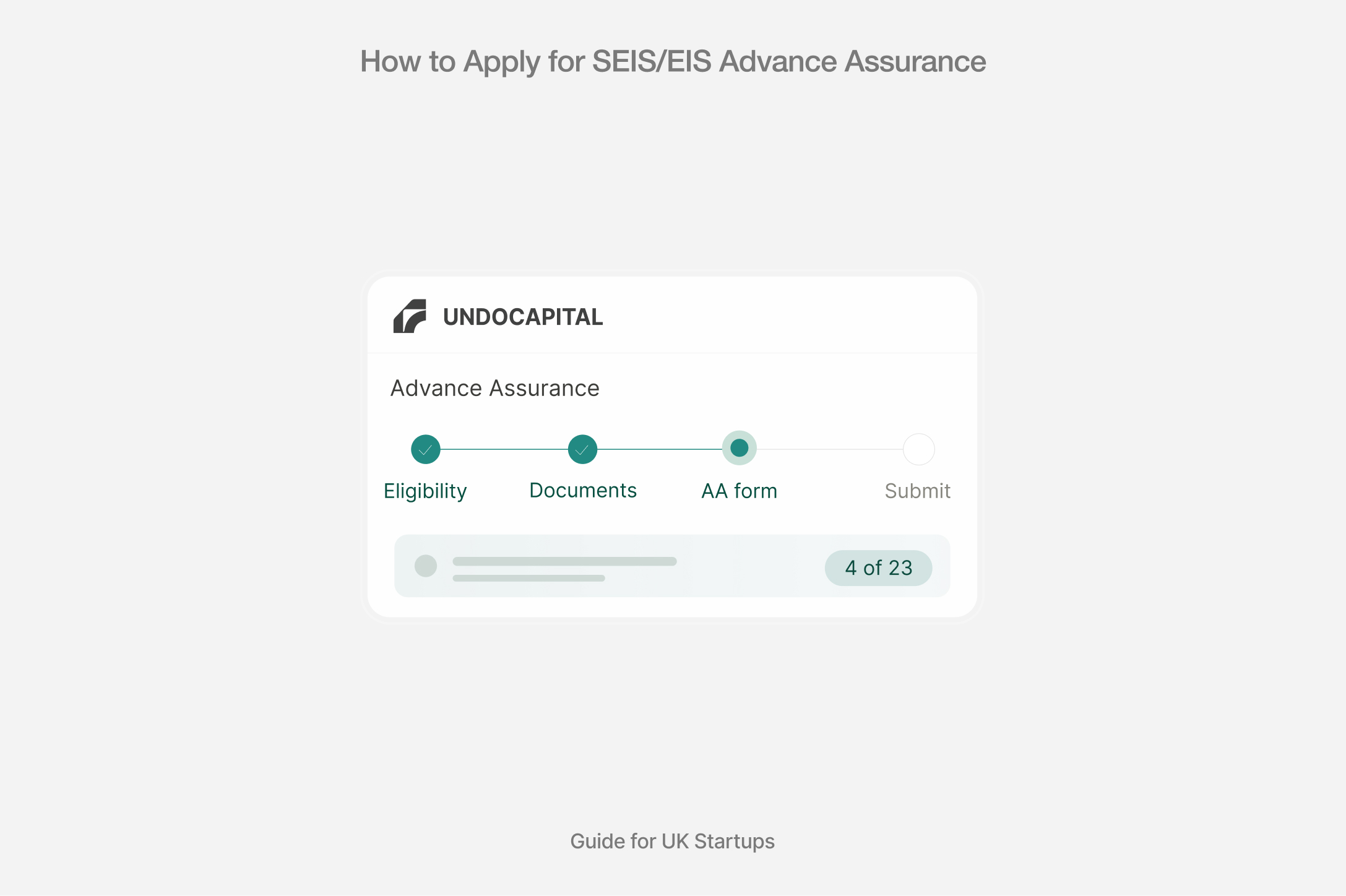
- Apply through HMRC's online advance assurance form; a director, the company secretary or an authorised agent can submit it, and one application can cover SEIS and EIS for a mixed round.
- Include the amount you plan to raise, business plan and forecasts, accounts, articles, a dated register of members, draft investor documents, a risk-to-capital explanation and named potential investors.
- HMRC publishes no timescale; after approval, issue SEIS shares before EIS shares, file SH01s, then the SEIS1/EIS1 so HMRC can authorise SEIS3/EIS3 certificates.
To apply for SEIS or EIS Advance Assurance, a director, company secretary or authorised agent completes HMRC's online advance assurance form and uploads the business plan, forecasts, latest accounts, articles, a dated register of members, draft investor documents, a risk-to-capital explanation and details of potential investors. HMRC publishes no fixed timescale and contacts you with its decision.
What Advance Assurance is, and whether you need it
Advance Assurance is HMRC's non-binding view that a proposed share issue is likely to meet the SEIS or EIS conditions, based on the facts you give it. It is optional, but most UK angels and syndicates will not invest without it.
It is not a guarantee of relief. Relief still depends on the facts when the shares are issued, on your compliance statement (SEIS1 or EIS1) and on each investor's own position. It also only covers the share issue you described, so a later round needs a new application. For the wider case for applying, see why Advance Assurance matters before raising.
Step 1: Check that the company qualifies
Before you prepare anything, confirm the company and the round fit the scheme limits. A failed test here cannot be fixed by better paperwork.
SEIS/EIS eligibility checker
Five questions. See if you could qualify for SEIS or EIS.
The main limits for 2026/27:
| Condition | SEIS | EIS |
|---|---|---|
| Age of trade | Trade began less than 3 years before the share issue | Within 7 years of first commercial sale (10 for knowledge-intensive companies) |
| Gross assets | £350k or less before the issue | £30m or less before and £35m or less after the issue |
| Employees | Fewer than 25 full-time equivalents | Fewer than 250 (500 for knowledge-intensive companies) |
| Company limit | £250k lifetime | £10m a year, £24m lifetime (£20m and £40m for knowledge-intensive companies) |
| Investor limit and relief | £200k a tax year, 50% income tax relief | £1m a tax year (£2m if the excess goes into knowledge-intensive companies), 30% relief |
| Spend the money within | 3 years of the share issue | 2 years of the share issue (or of starting to trade, if later) |
| Order of issue | Before any EIS shares, on an earlier day | From the day after the SEIS shares; no SEIS afterwards |
| EIS figures apply to shares issued on or after 6 April 2026. Before that the limits were £5m a year and £12m lifetime, with gross assets of £15m before and £16m after. Companies in Northern Ireland trading in goods or electricity keep the old limits. | ||
Also check that no more than about 20% of your activities are excluded (for example property development, financial services or energy generation), that the company is not controlled by another company, and that any subsidiaries qualify. Our guide to SEIS/EIS eligibility criteria covers each test in detail.
Step 2: Plan the round you are asking about
HMRC assesses a specific proposed investment, so decide the amounts, the instrument and the order of issue before you apply. One application can ask for assurance under both SEIS and EIS for a mixed round.
- Amounts: SEIS is capped at £250k over the company's life; anything above goes under EIS.
- Order: SEIS shares must be issued on an earlier day than EIS shares. If both are issued on the same day, the SEIS shares lose SEIS relief (EIS relief is not affected). You do not need a separate share class, and you do not need to file the SEIS1 before issuing the EIS shares.
- Instrument: ordinary shares, or an Advance Subscription Agreement (ASA) that meets HMRC's conditions: long-stop date no more than six months after signing, no interest, no refund, no variation, terms fixed at signing and conversion into ordinary shares. Convertible loan notes and SAFEs do not qualify.
Step 3: Prepare the documents HMRC asks for
HMRC's guidance lists the information it needs. The table maps each item to what to include and where applications usually fall short.
| HMRC asks for | What to include | Common gap |
|---|---|---|
| Amount you plan to raise | SEIS and EIS amounts separately, with expected dates | A single round total with no split |
| Business plan and forecasts | Product, market, team, use of funds; 3-year forecast that matches the raise | Forecast that spends more than you are raising |
| Latest accounts | Filed accounts, or management accounts if you have not filed yet | Omitted for young companies when they exist |
| Companies that will use the money | Group chart if you have subsidiaries | Holding company with a non-qualifying subsidiary |
| Trading activities and spend | Each activity and the expected spend on it | Excluded activities not mentioned |
| Memorandum and articles | Current version plus any changes planned for the round | Articles with preferential rights for the new shares |
| Register of members | Dated on the day you apply | Out of date or not matching the cap table |
| Investor documents | Latest draft pitch deck, information memorandum, term sheet, subscription agreement or ASA | Drafts that contradict the business plan |
| Shareholder agreements | Any agreement between the company and shareholders | Side letters with put options or guarantees |
| Risk to capital | Growth objectives and why investors could lose money | Generic statement copied from a template |
| Potential investors | Name and address of each prospective investor, or platform or fund manager evidence | Left blank on a first application |
Make the numbers agree across every document. If you say £120k goes on engineering, the hiring plan should show the roles and start dates, and the forecast should show the cost. A full checklist is in what documents you need for Advance Assurance.
Step 4: Explain how you meet the risk-to-capital condition
Every SEIS and EIS application must explain how the company meets the risk-to-capital condition: it must intend to grow and develop its trade over the long term, and investors must face a significant risk of losing more capital than they could gain as a net return. For EIS, also explain how the money will be used for growth and development.
A short, specific memo works best:
- Growth plan: what the money pays for (hires, product, new markets) and the milestones it reaches, with numbers and dates.
- Why capital is at risk: untested product, competition, execution risk, and no guaranteed return or planned exit.
- No protection: confirm the shares are ordinary and non-redeemable, with no linked loans, guarantees, put options or side arrangements.
- Time horizon: the company is building a long-term business, not a vehicle to return capital quickly.
Step 5: Name your potential investors
If the company has not used a venture capital scheme before, HMRC requires details of potential investors. Even repeat applicants may need them, because they help HMRC assess risk to capital.
- Raising directly from angels: each prospective investor's name and address.
- Through a crowdfunding platform: evidence that the platform has accepted your proposal and will keep working with you.
- Through a fund manager or business promoter: evidence that they have agreed to act for you.
You do not need to have closed the round, and you do not need to raise the full amount in your application. Applications with no named investors are treated as speculative and are not considered.
Step 6: Submit the online form
Submit through HMRC's online advance assurance service, which you reach from the "Start now" button on the GOV.UK guidance page. You need to sign in, and you can create sign-in details if you do not have them.
- Who can apply: a director, the company secretary, or an agent authorised by the company.
- Agents: must upload a letter signed by a director, dated within the last three months, confirming their authority, with every new application.
- One application per proposed investment: a later round needs its own application.
Step 7: Answer HMRC's questions quickly
HMRC may ask for more information on the trade, share rights, group structure or investors, and it gives no service standard for decisions. Reply quickly and consistently with what you submitted.
If the application is refused, HMRC explains which condition it does not meet. If it is incomplete, it is not considered and HMRC gives no feedback, so a complete pack is the fastest route. Queries about an application go to HMRC's Enterprise Centre at enterprise.centre@hmrc.gov.uk. For the reasons applications are refused, see Advance Assurance rejections and how to avoid them.
Step 8: After you receive the letter
If HMRC agrees, it sends a statement that the investment is likely to qualify, which you can share with investors. The relief itself comes later, through the compliance statement. To see what the relief is worth on a given cheque, try our SEIS/EIS tax relief calculator.
- Issue the shares: SEIS first, EIS on a later day. File an SH01 with Companies House within one month of each allotment and issue share certificates within two months.
- File the compliance statement: SEIS1 once the company has traded for four months or spent 70% of the SEIS money; EIS1 once it has traded for four months. Report any changes since your application, or the assurance no longer applies.
- Issue certificates: HMRC authorises the company to issue SEIS3 or EIS3 certificates, which investors use to claim relief.
The full sequence is in what happens after you receive SEIS/EIS approval.
Worked example: a mixed £600k round
A company that started trading 18 months ago, with £120k of gross assets and 6 employees, plans to raise £600k: £250k under SEIS from five angels and £350k under EIS from a syndicate and two angels.
- Application: one Advance Assurance application describing both tranches, naming all seven angels with addresses and attaching the syndicate lead's confirmation.
- Documents: a business plan showing the £600k funds four hires and 18 months of runway, a forecast that reconciles to it, current articles, the register of members dated on the day of application and the draft subscription agreements.
- Issue: after receiving assurance, the company allots the SEIS shares on 3 March and the EIS shares on 4 March, files two SH01s and issues share certificates.
- Compliance: four months after trading began has long passed, so the SEIS1 and EIS1 can be filed once the shares are issued. Each SEIS investor investing £50k can claim £25k of income tax relief; an EIS investor putting in £100k can claim £30k.
Applying with Undo Capital
Undo Capital's Advance Assurance module turns your existing files into a draft application. You upload documents such as your pitch deck and financial model and answer a few questions; the system drafts the application from them.
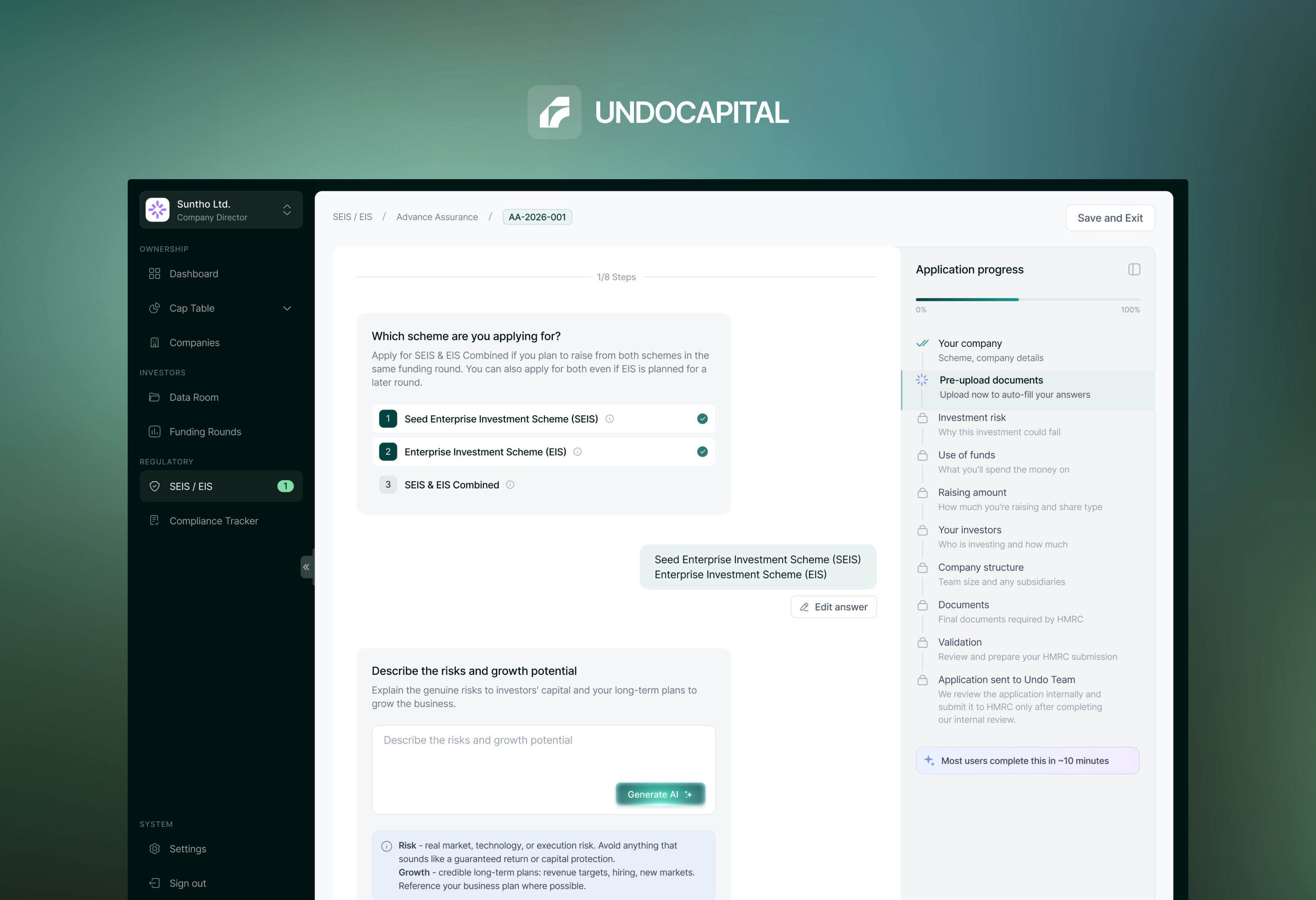
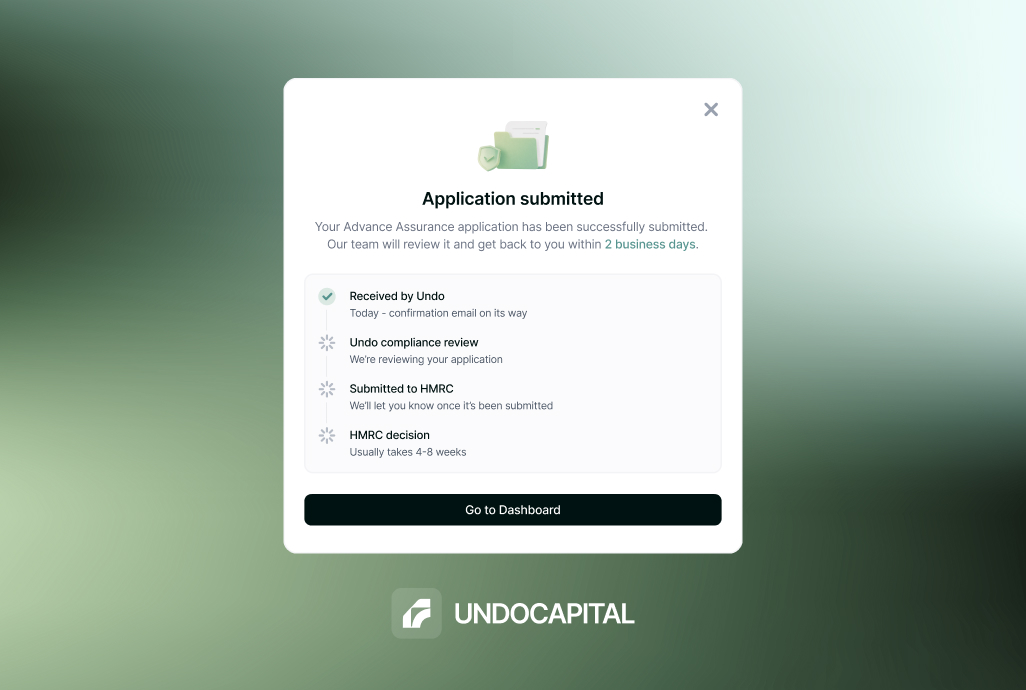
Undo Capital operators, working with partner lawyers, then review the draft and submit it to HMRC for you, and the application can be ready to submit within 24 hours. HMRC, not Undo Capital, decides the application and issues the letter, and its decision time is outside anyone's control. The AI Copilot can answer questions about the HMRC rules involved, using your company's live data room, cap table and rounds.
How long Advance Assurance takes and lasts
HMRC publishes no processing time; it says only that it will contact you when it makes a decision. Allow several weeks, more around the end of the tax year, and avoid promising investors a date.
Assurance has no fixed expiry date, but it covers only the share issue you described. If the facts change materially, such as a different amount, share rights or use of funds, it no longer covers the revised proposal, and you should report the changes on the compliance statement or apply again. More detail is in how long EIS Advance Assurance lasts.
Common mistakes that delay Advance Assurance
No investor details
First-time applicants must name prospective investors or show platform or fund manager engagement. HMRC does not consider speculative applications.
Preferential share rights
Redemption rights, cumulative dividends, liquidation preferences or guaranteed exits fail the share and risk-to-capital conditions. Use full-risk ordinary shares.
A vague risk-to-capital statement
HMRC wants the specific growth plan the money funds and the real reasons investors could lose capital.
Ignoring the group
Asset and employee limits are tested across the group, and every subsidiary must be a qualifying subsidiary.
Wrong instrument
Convertible loan notes and SAFEs do not qualify. An ASA can, if it meets HMRC conditions, including a long-stop date no more than six months after signing.
Numbers that do not reconcile
The raise, forecast, use of funds, cap table and register of members must tell the same story.
Prepare your application in Undo Capital
If you would rather spend your time with investors than on appendices, Undo Capital's Advance Assurance module drafts your application from the files you already have, and the same platform runs your funding round, cap table, share certificates and SEIS1/EIS1 compliance statements afterwards.
FAQs
How do I apply for SEIS Advance Assurance?

Use HMRC's online advance assurance form, reached from the GOV.UK guidance page. A director, company secretary or authorised agent signs in, describes the proposed investment and uploads the business plan, forecasts, accounts, articles, register of members, draft investor documents, a risk-to-capital explanation and details of potential investors. HMRC contacts you with its decision.
Do I need separate Advance Assurance for SEIS and EIS?
No. One application can request assurance under both SEIS and EIS for a mixed round, as long as HMRC can see the facts for each proposed share issue. You do need a new application for each later round. When you issue the shares, SEIS shares must be issued on an earlier day than the EIS shares.
How long does SEIS/EIS Advance Assurance take?
HMRC publishes no processing time and simply contacts you when it has decided. Allow several weeks, longer near the end of the tax year, and more if HMRC needs to ask questions. A complete, consistent application with named investors avoids most delays, because incomplete applications are not considered at all.
Is Advance Assurance mandatory before raising?
No. It is optional and does not bind HMRC, and a company can issue SEIS or EIS shares and file its compliance statement without it. In practice most UK angels and syndicates will not invest without an Advance Assurance letter, because it shows HMRC has reviewed the proposed share issue first.
What happens if HMRC refuses Advance Assurance?
HMRC explains which scheme condition it thinks is not met. You can fix the issue, for example by removing preferential share rights, restructuring the group or rewriting the risk-to-capital explanation, and apply again. If the application was simply incomplete, it is not considered and HMRC gives no feedback, so check every document first.
References
- Venture capital schemes: apply for advance assurance - GOV.UK
- VCM60010: Advance assurance - HMRC internal manual
- Apply to use the Seed Enterprise Investment Scheme to raise money for your company - GOV.UK
- Apply to use the Enterprise Investment Scheme to raise money for your company - GOV.UK
- VCM8542: Risk-to-capital condition - HMRC internal manual
- Tax relief for investors using venture capital schemes - GOV.UK
Disclosure Notice: This communication is issued by Undo Capital Limited (“Undo Capital”) and is provided strictly for informational purposes only. It contains general information and should not be relied upon as accounting, business, financial, investment, legal, tax, or other professional advice. Undo Capital is not regulated by the Financial Conduct Authority (FCA) and does not provide investment, financial, or tax advice. Our services are designed to assist startups and businesses with company formation, legal agreements, and funding-related documentation. Nothing in this communication constitutes, or should be construed as, a recommendation, offer, or solicitation to purchase or sell any security or financial instrument.
Participation in startups and early-stage enterprises involves significant risk. Such investments may be illiquid, may not generate dividends, may be subject to dilution, and may result in the total loss of invested capital. Any decisions or actions that may affect your business or personal interests should be taken only after seeking advice from suitably qualified professional advisors, and should form part of a balanced and diversified portfolio. This communication may contain links to third-party websites. The inclusion of such links does not imply endorsement, approval, investigation, or verification by Undo Capital. We accept no responsibility or liability for the content, accuracy, or use of information contained on any third-party websites.
Latest articles

SEIS and EIS tax relief calculator
Founders agreement template UK: what every co-founder should include