Founders Agreement Template UK: What Every Co-Founder Should Include



- A vague equity split leaves ownership, work and exit terms open to argument.
- Missing IP assignments can leave core code or designs with their creator.
- A signed deal loses value when the cap table, articles and filings tell a different story.
A founders agreement template helps a UK startup record the deal between its founders. Get the free template, customise it for your company and agree the terms with your co-founders. Then add the agreed shares and vesting to Undo Capital’s cap table.
This founders agreement template UK guide applies to teams in England and Wales. It is a structured starting point, not legal advice. Complex share rights, overseas founders and strict post-exit limits need legal review.
A founders agreement also helps protect the founders themselves by setting expectations early and reducing the risk of disputes as the company grows. When you start raising investment, prospective investors will often want to understand the arrangements between the founding team as part of their due diligence.
Having the agreement in place before a funding round can make that process smoother. The ownership and vesting agreed between founders should also be reflected accurately in the company’s records and cap table.
Get your free founders agreement template
The search for a founders agreement template should end with something you can actually use. Download our free basic template, customise it for your startup and use it to document the key terms agreed between the founders.
Sign up to access the free template
The template gives UK startup founders a structured starting point for putting their agreement in writing. Edit it with your company and founder details, review the terms together and sign the completed agreement.
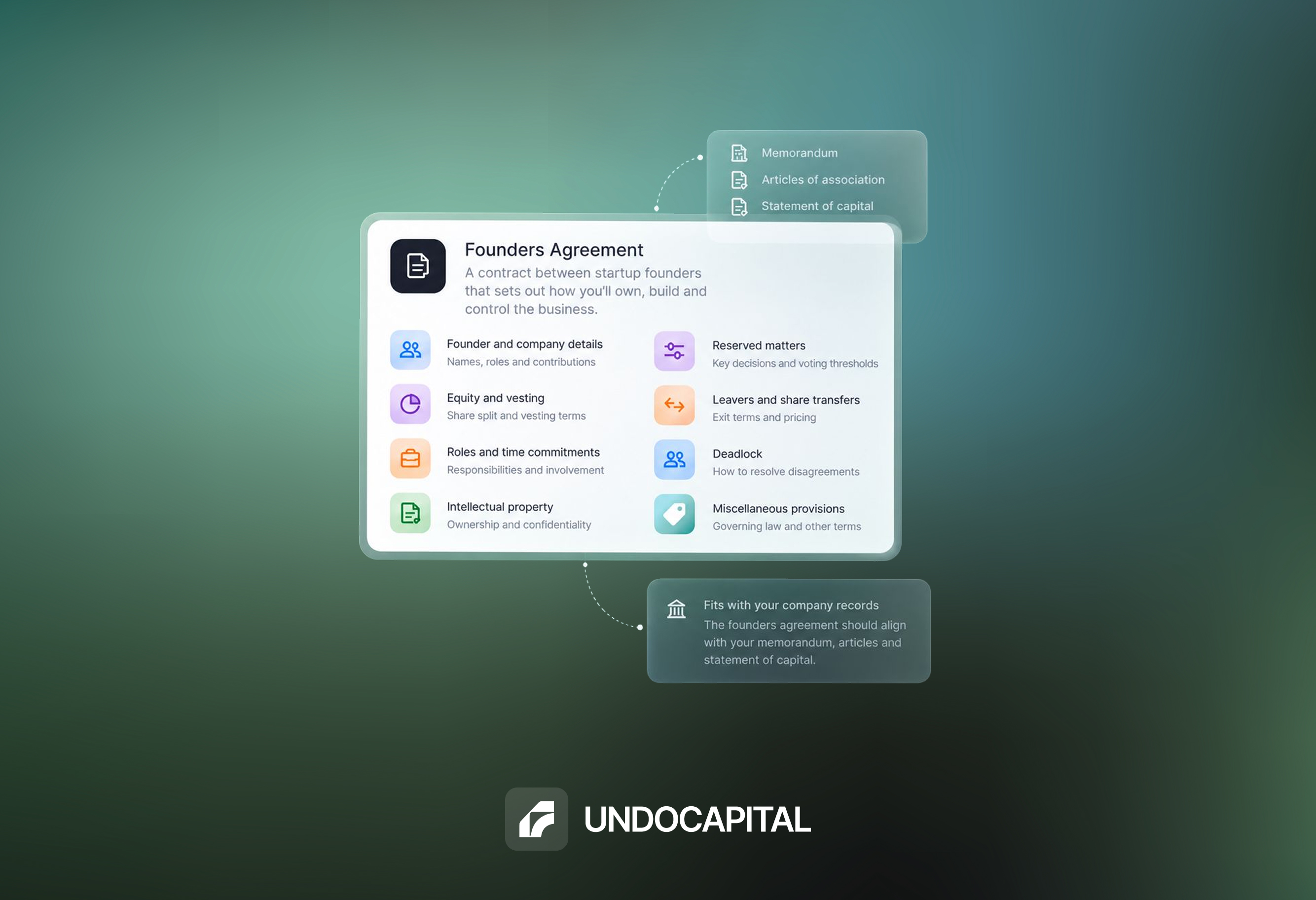
The template covers the key areas of the founder relationship:
- Founder and company details
- Equity, contributions and vesting
- Roles and time commitments
- Intellectual property and confidentiality
- Reserved matters and voting thresholds
- Leavers and share transfers
- Deadlock provisions
The basic founders agreement template is designed for startup teams in England and Wales. It is a starting point rather than legal advice, so consider legal review where you have complex share rights, overseas founders, strict post-exit restrictions, disputed IP or other non-standard arrangements.
Putting these terms in writing helps protect the founding team and reduce the risk of disagreements later. It can also help you prepare for fundraising, when investors may want to review the arrangements between founders as part of their due diligence.
Once the agreement is signed, add the agreed share ownership and vesting terms to Undo Capital so your cap table reflects the deal between the founders.
What is a founders agreement?
A founders agreement is a contract between startup founders. It records how they plan to own, build and control the business. It can cover work before and after incorporation.
Common labels include founder agreement, founders contract and co founder agreement. The title matters less than the rights inside it. English contract formation rests on agreement, intent to create legal relations and consideration, among other points, as set out in HMRC’s contract guidance.
Emails can record facts. They rarely cover leaver pricing, deadlock or an IP chain in enough detail.
After incorporation, the company has its own formal records. GOV.UK lists the memorandum, articles and statement of capital among the documents used to form a limited company. The founders agreement must fit those records.
When should UK founders sign?
Use a founder agreement before money, work and ownership become hard to separate. Aim to sign before or near incorporation.
Set the terms before founders create key code or designs. Do it before shares are issued. Revisit the document before a new co-founder joins or a funding round starts.
An incorporated team can still sign. First check the articles, share issues, service terms and IP documents. A change to the articles needs shareholder agreement. The resolution and revised articles must reach Companies House within 15 days, according to Companies House guidance on constitutional changes.
A deal that says “60%” has little use if the register of members says something else. UK companies must keep that register at the registered office or one named alternative location, under the current company-register rules.
What should a founders agreement template include?
The right clauses turn shared intent into steps people can follow. The final mix depends on the company, the founders and the planned raise. Each term must fit the articles, share records and related contracts.
Equity split, contributions and vesting
Write down each founder’s shares, percentage and contribution. Record cash, equipment, code, customer access and expected work. State whether any promised shares have been issued.
Do not write “equal split” and stop. Define the numbers. Two founders can agree 600 and 400 ordinary shares. At a £0.01 nominal value, total nominal share capital is £10. That is not a company valuation. GOV.UK explains the difference in its company-formation document guide.
Next, decide whether founder equity vests. A team might use four years with a one-year cliff. That pattern is not a legal rule. State the start date, vesting rate and treatment of unvested shares.
Model dilution too. In a 60/40 company, an investor taking 20% post-money leaves the founders with 48% and 32%. Then manage your startup cap table using the same share counts and terms.
Roles, time commitments and decisions
Name the job each founder owns. Add expected hours, pay and reporting. Set limits on contracts, hiring, borrowing and spending.
Separate daily calls from reserved matters. A share issue, sale or large loan can need a higher threshold. Name it. Do not use “major decision” without a list or value limit.
Add a cure process for missed work. Give notice, set a review date and state the next decision. This turns a vague duty into an action the team can run.
Intellectual property and confidentiality
List IP that exists now. Name its owner and how the company gets the rights it needs. Cover code, designs, domains, data, research, trade marks and product copy.
Do the same for new work. A self-employed creator usually owns commissioned IP where the contract does not transfer it, according to the UK government’s IP ownership guide. A copyright transfer needs a written, signed assignment, as explained in the official copyright assignment guidance.
Make contractor terms part of the checklist. Ask each developer and designer to sign the right IP wording. List earlier work that stays outside the company.
Define confidential information and permitted disclosure. State what each person must return or delete after departure.
Founder departures, share transfers and deadlock
Decide what happens when a founder leaves. Cover resignation, death, illness, dismissal and serious breach. Link each event to vested and unvested shares.
Set the share price method. It can use nominal value, fair value or a formula. Name the assessor, date and process. Get tax and legal review.
Add transfer limits and pre-emption rights. State who can buy first, how notice works and the reply deadline. Make the terms fit the articles.
For deadlock, set an escalation path. Start with a meeting and written issue note. Move to a named mediator. Add any forced sale or buyout route only after review.
This co founder agreement section should name the governing law and courts. Cross-border teams need advice on service, tax and enforcement.
Founders agreement vs shareholders agreement vs articles
These documents can cover the same event from different angles. Read them together. A mismatch can leave a private promise outside the company records.
Every UK limited company must have articles. A company can use model articles or file its own, under Companies House guidance on model articles. A founders agreement is not on the statutory incorporation list.
A shareholders’ agreement can build on an early founders contract after a raise. Check votes, transfers, leaver terms and share rights across all three documents.
The cap table is the working view of ownership, not a substitute for a contract. Learn how to build a cap table step by step, then check it against the register of members.
How to complete a founders agreement template in six steps
Use this order. It puts the hard talks before the drafting work.
- Gather the facts. List each founder, the company, share numbers, cash, assets, IP and work commitments.
- Settle the hard points. Agree equity, vesting, votes, pay, exits and deadlock. Record open points in a decision log.
- Customise each clause. Replace names, dates, amounts and thresholds. Remove spare options and drafting notes.
- Reconcile the records. Check the articles, register of members, share certificates, service contracts and IP assignments. A later share issue must be reported to Companies House within one month, under its guide to company changes.
- Review and sign. Get legal review where the deal has complex rights, strict covenants or overseas parties. Use the execution block in the approved draft.
- Update the operating records. Put the share counts, vesting and investor details into the cap table and fundraising files.
For cost context, digital company incorporation is £100. The first digital confirmation statement in each 12-month payment period is £50. Those Companies House prices were current on 2 July 2026 in the official fee list.
Founder decision worksheet
Use this short worksheet before editing the founders agreement template. It exposes gaps that boilerplate cannot solve.
Turn the agreement into an investor-ready equity workflow
A signed agreement defines the deal. Investors and advisers will still compare it with the articles, register of members, cap table and issue documents.
HMRC asks for current articles, the register of members and other shareholder agreements in an SEIS or EIS Advance Assurance application. See its official Advance Assurance guide. Private terms soon become part of a live funding process.
Undo Capital is UK-first equity and fundraising software, not a law firm or accountancy practice. Founders can track shares and dilution in a live cap table, run a funding round, organise an investor data room and prepare an SEIS or EIS workflow.
Keep one set of source data. Store the signed founder agreement and IP assignments beside the cap table records.
Start free with Undo or review the Undo product overview.
Put the founder deal into practice
Finish the document, but do not stop at signatures. Reconcile its share numbers, vesting and rights with the articles, register of members and cap table. Put the same records into the funding room.
Use the approved founders agreement template UK resource as your starting point.
Complete the founder decision worksheet and settle each open point. Add the agreed ownership to Undo’s cap table before the next share issue or investor review.
FAQs
Is a founders agreement legally required in the UK?

No. It is not a statutory company-formation document. A UK limited company does need articles of association. Founders use a separate agreement to record private terms on equity, work, IP, votes and exits. The GOV.UK formation list sets out the required company documents.
Is a founders agreement legally binding?
It can form a binding contract. The result turns on its wording, formation, parties and execution. A signature does not repair vague or unlawful terms. Use legal review for complex vesting, restrictive covenants, overseas founders or disputed IP.
What is the difference between a founders agreement and a shareholders’ agreement?
The first often records the original founders’ early deal. The second can cover a wider shareholder group after investors join. Their terms can overlap. Both must fit the articles and ownership records.
What clauses should a co founder agreement include?
A co founder agreement should cover equity, contributions, vesting, roles, time, votes, IP, confidentiality, exits, transfers, deadlock and governing law. Customise each clause. A generic co founder agreement cannot choose the commercial terms for the team.
Can I use a founders agreement template without a solicitor?
You can use a founders agreement template to structure talks and prepare a draft. Get legal review where equity is complex, core IP has several owners, founders live in different countries or the draft contains strict post-exit limits.
References
- Set up a private limited company: Prepare documents agreeing how to run your company - GOV.UK
- Make changes to your private limited company: Constitution and articles of association - GOV.UK
- Changes to company registers
- Intellectual property and your work
- How copyright protects your work: License and sell your copyright - GOV.UK
- Model articles of association for limited companies - GOV.UK
- Companies House fees - GOV.UK
Disclosure Notice: This communication is issued by Undo Capital Limited (“Undo Capital”) and is provided strictly for informational purposes only. It contains general information and should not be relied upon as accounting, business, financial, investment, legal, tax, or other professional advice. Undo Capital is not regulated by the Financial Conduct Authority (FCA) and does not provide investment, financial, or tax advice. Our services are designed to assist startups and businesses with company formation, legal agreements, and funding-related documentation. Nothing in this communication constitutes, or should be construed as, a recommendation, offer, or solicitation to purchase or sell any security or financial instrument.
Participation in startups and early-stage enterprises involves significant risk. Such investments may be illiquid, may not generate dividends, may be subject to dilution, and may result in the total loss of invested capital. Any decisions or actions that may affect your business or personal interests should be taken only after seeking advice from suitably qualified professional advisors, and should form part of a balanced and diversified portfolio. This communication may contain links to third-party websites. The inclusion of such links does not imply endorsement, approval, investigation, or verification by Undo Capital. We accept no responsibility or liability for the content, accuracy, or use of information contained on any third-party websites.
Latest articles
SEIS and EIS Tax Relief Calculator
Founders Agreement Template UK: What Every Co-Founder Should Include