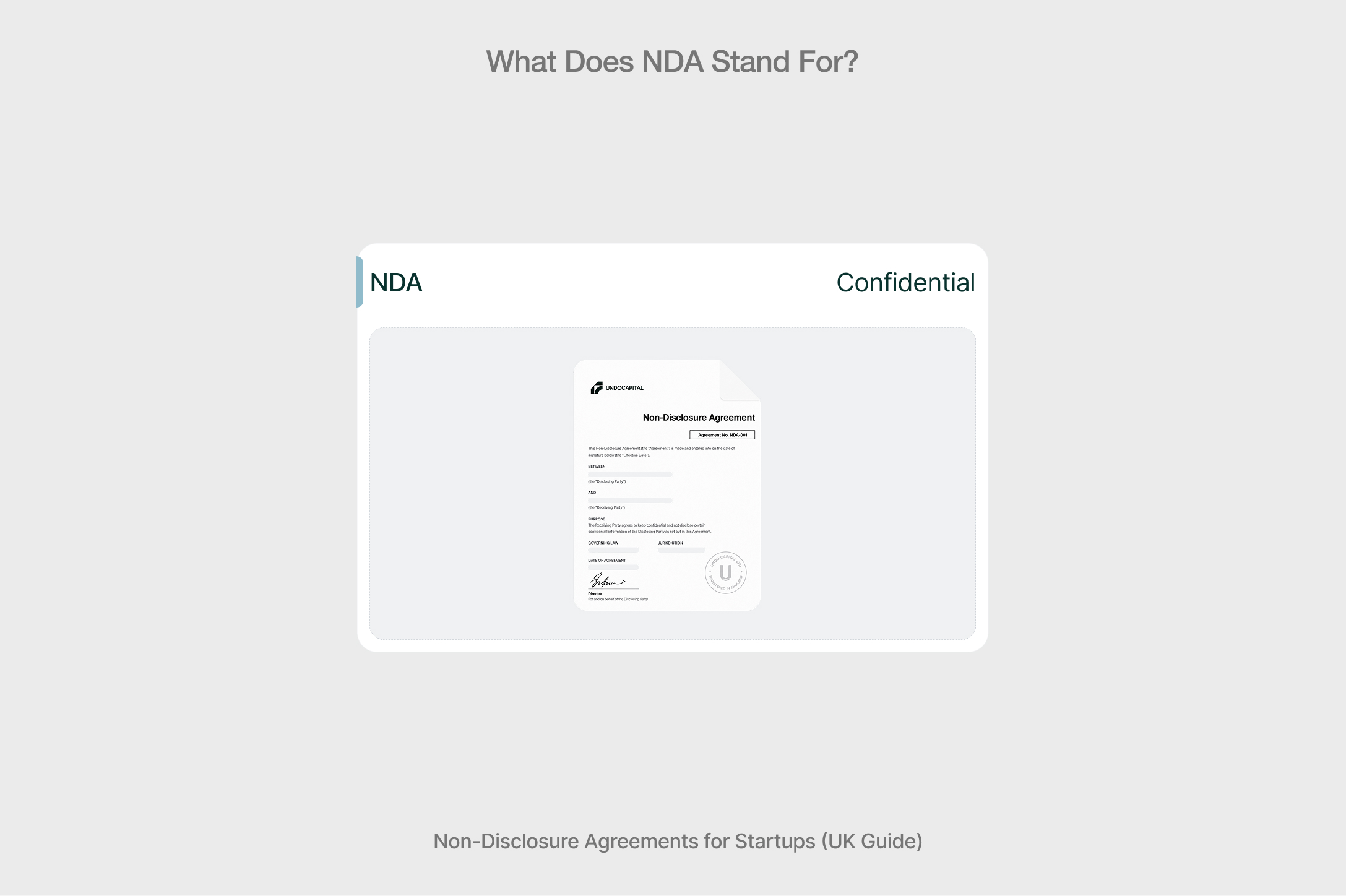
What Does NDA Stand For? Non-Disclosure Agreements for Startups (UK Guide)



- Vague wording creates paperwork but may not protect the information that gives your startup value.
- Most institutional investors will not sign an NDA before a first pitch, so disclose sensitive details in stages.
- The contract cannot repair weak IP assignments, loose access controls or an inaccurate cap table.
NDA stands for Non-Disclosure Agreement: a contract that controls how confidential information may be used and shared. For a UK founder, that information might be source code, a roadmap, pricing, customer data or an invention discussed before a patent filing.
The agreement helps when the information is specific, valuable and still private. It helps far less when a founder tries to protect a broad idea, sends the same template to every investor or relies on secrecy instead of securing IP ownership.
This guide answers what an NDA stands for, when startups should use one and what it must contain. Searches such as "what is an NDA?" raise the same concern: how can you share enough without giving away the part that matters?
What does NDA stand for?
NDA stands for Non-Disclosure Agreement. It may also be called a confidentiality agreement, confidentiality deed or secrecy agreement. It creates a duty to keep defined information confidential and use it only for an agreed purpose.
What does NDA stand for in business? It is the written boundary around a confidential exchange. A startup may use one when sharing algorithms, supplier terms, security architecture, product specifications or unpublished financial forecasts.
The phrase NDA stands for in business discussions because a leak may weaken a negotiation, reveal a roadmap or expose an invention too early.
For founders asking what an NDA is or what an NDA in business is, the useful answer lies in the clauses: parties, protected information, permitted use, recipients, duration and remedies.
GOV.UK defines the document as a legal contract governing how information or ideas are shared in confidence. Its guidance also warns that founders should not assume every adviser is automatically bound to confidentiality.
A non-disclosure agreement UK founders sign must also identify the correct legal system. England and Wales, Scotland and Northern Ireland are separate jurisdictions. “UK law” is not precise drafting.
What is the purpose of an NDA?
The purpose of an NDA is to set the rules before sensitive information changes hands.
So, what is an NDA used for? It limits use to a defined purpose, controls access, records a confidential exchange and gives the discloser a contractual response to misuse.
This answers what is the purpose of an NDA, but it also shows what the document cannot do. It does not transfer copyright, patent rights or ownership of code. Those rights require clear employment, consultancy and IP-assignment terms.
The contract may also preserve future patent options. UK Intellectual Property Office guidance warns that public disclosure before filing can destroy the novelty required for patent protection.
A founder searching to protect a business idea in the UK may focus on the broad concept. Yet the real confidential assets are often the model, dataset, pricing logic and product workflow.
Types of NDA UK startups use
Use the form that matches the flow of information. Do not choose a mutual agreement merely because it appears more balanced.
GOV.UK distinguishes one-way and mutual NDAs. It notes that a one-way NDA may sometimes need execution as a deed where no consideration supports the promise.
One-way NDA
This form works when only one side expects to disclose sensitive information. A software startup might use one before a contractor reviews architecture documents or repository access.
Mutual NDA
A mutual NDA UK founders use protects both parties. It suits a technical partnership where each company shares roadmaps, security information and commercial terms.
Mutual does not mean sweeping. Each side should still know what it receives, why it receives it and which staff may see it.
Multilateral NDA
A multilateral agreement covers at least three parties. It can simplify a research project or shared pilot, but access still needs mapping.
Employee and contractor clauses
Employment and consultancy agreements should also address IP ownership, data security and post-termination duties.
For key hires, review confidentiality alongside employee equity and option arrangements.
A search for a non-disclosure agreement for IT company staff often leads to a generic form. Use UK-specific employment or consultancy terms instead. A stand-alone startup NDA agreement rarely covers the whole relationship.
When should a UK startup use an NDA?
Use a confidentiality agreement when the information is identifiable, non-public and commercially important. The recipient must also need it for a real purpose.
A UK startup NDA often makes sense when:
- a developer needs code, diagrams or private datasets;
- a manufacturer needs drawings or an unreleased specification;
- a partner needs API documents, pricing or customer-flow data;
- a buyer needs acquisition diligence material; or
- a senior hire will see strategy, forecasts or customer contracts.
Consider a pre-seed company seeking quotes for a product rebuild. Public screenshots may be enough at first. Only the shortlisted agency needs repository access, security notes and conversion data. Sign before opening that second layer.
That is how to use an NDA for business idea discussions. Start with public evidence. Move to private detail when the counterparty has a serious role.
A non-disclosure agreement for business idea discussions works best once the idea has become specific know-how: a process, formula, dataset or implementation method.
You may also see this written online as an NDA startup or startup NDA. The label matters less than the fit between the document and the disclosure.
Will investors sign?
Most institutional investors will not sign one before a first pitch. They review many companies in related markets and avoid liability whenever another opportunity looks similar.
Pitch the team, market, evidence and business model first. Share customer names, code, security detail and unpublished IP only during serious diligence.
Use a staged investor-ready data room and record access. GOV.UK also recommends recording what was disclosed in meetings and presentations.
The investor rule: protect the detail, not the existence of the company.
When you do not need an NDA
A confidentiality contract is not the default answer to every conversation. Used badly, it delays feedback and can signal that the founder misunderstands normal investor practice.
You may not need one for public product information, generic market research, a high-level investor introduction or an early customer interview that reveals no private data.
Broad wording may also backfire. If every idea and discussion is confidential, the recipient may struggle to follow the restriction.
Ask a sharper question: what exact information am I protecting, and why must this person see it?
Founders sometimes guard ideas while leaving ownership untidy. A confidentiality contract cannot fix missing IP assignments, a disputed founder split or unclear ownership.
Before fundraising, review the shareholders’ agreement, founder vesting, contractor terms and startup cap table. Those records often matter more in diligence than old confidentiality files.
What a UK startup NDA should include
A usable agreement tells both parties what to do. It does not merely state that everything is confidential.
Definition of confidential information
Define the protected material clearly. Cover the relevant written, oral, visual and electronic forms. Avoid wording that captures public knowledge or ordinary professional skill.
Permitted purpose
State exactly why the information is being shared. This might be evaluating a software build, considering a partnership or conducting acquisition diligence.
GOV.UK advises parties to define the permitted purpose precisely. A narrow purpose can be widened later, but an overly broad permission is difficult to pull back after disclosure.
Permitted recipients
Limit access to staff, directors and advisers who need it. Require equivalent duties and use role-based permissions. Contract wording cannot compensate for an open drive.
Exclusions
Exclude information that is already public, lawfully known, received from another lawful source, independently developed or required to be disclosed by law.
These carve-outs stop the agreement claiming control over information the discloser does not own.
Duration
Separate the life of the discussions from the confidentiality period. Talks may end in three months while confidentiality lasts three years.
Match the term to the information. A forecast ages quickly. Source code, a formula or non-patentable know-how may remain valuable for much longer.
Return or destruction
Require return or deletion when talks end. Any retained copy should remain under NDA.
Governing law and remedies
Choose England and Wales, Scotland or Northern Ireland. For cross-border deals, consider where the recipient and assets sit. The agreement may mention damages and urgent court relief, but cannot guarantee an injunction.
Signatures and evidence
Check the legal entity, company number and signatory authority. Then operate the agreement.
Mark sensitive files. Keep a disclosure log. Revoke access when the project ends. An unsigned template in a shared drive protects nothing.
How long does an NDA last?
Most UK startup NDAs use a confidentiality period of three to five years. GOV.UK describes three or five years as common, while recognising that some information may need longer protection.
Founders asking how long an NDA lasts may expect one fixed legal answer. There is none. Consider how quickly the information becomes stale, whether competitors could still use it and whether the recipient can comply.
A forecast may need 12 to 24 months. A roadmap may justify two or three years. A secret process may need protection while it remains secret.
Indefinite drafting is not automatically stronger. Link longer protection to information that remains genuinely confidential and commercially sensitive.
UK legal framework: what founders need to know
A non-disclosure agreement is a contract, but it sits beside wider common-law and statutory rules.
Contract, confidence and trade secrets
A signed agreement creates express duties. English law may also protect information through the common-law duty of confidence.
The Trade Secrets (Enforcement, etc.) Regulations 2018 provide measures for unlawful acquisition, use or disclosure of trade secrets alongside breach-of-confidence remedies.
Protection still depends on practice. Restrict access and remove permissions when roles end.
UK GDPR
A confidentiality contract does not create a lawful basis for sharing personal data. If a diligence folder contains employee details, customer records or identifiable usage data, UK GDPR still applies.
The ICO says organisations must identify and document their lawful basis for data sharing. Special-category and criminal-offence data require additional conditions.
Use redaction, anonymisation and controlled access. “Confidential” does not mean “lawful”.
Protected disclosures and crime reporting
A confidentiality clause cannot validly stop a worker making a protected whistleblowing disclosure. It cannot lawfully prevent reporting criminal conduct to the police.
Since 1 October 2025, section 17 of the Victims and Prisoners Act 2024 has made certain NDA restrictions unenforceable for victims of crime in England and Wales. Protected routes include specified disclosures to police, lawyers, regulated professionals, victim-support services and regulators.
Higher education providers in England have also been barred since 1 August 2025 from using NDAs to silence specified complaints about abuse, misconduct, bullying or harassment.
The Employment Rights Act 2025 contains wider restrictions on employer-worker NDAs concerning harassment and discrimination. As of July 2026, those provisions are enacted but await commencement after consultation. Legitimate commercial NDAs for sensitive information, ideas and IP remain permitted.
Common NDA mistakes UK founders make
- Using a US template unchanged. US legal and employment language may not fit a confidentiality agreement UK companies need.
- Defining everything as confidential. Wide wording can obscure the assets that matter.
- Leaving out the purpose. The recipient cannot follow an undefined rule.
- Ignoring oral disclosures. State how they will be recorded or confirmed.
- Missing exclusions. Address public, previously known and independently developed information.
- Choosing “UK law”. Name the jurisdiction and courts.
- Trying to bind every VC. Use staged disclosure instead.
- Treating confidentiality as IP ownership. Secure assignments from founders, staff and contractors.
- Forgetting data protection. Confidential wording cannot legitimise unlawful sharing.
- Failing to revoke access. Close accounts and retrieve files when work ends.
A free template can suit a low-risk discussion. For core IP, a key hire or cross-border deal, obtain advice before disclosure.
An NDA is only one layer of protection
A good agreement gives a serious conversation a clear boundary. It does not make a broad idea ownable. It does not transfer IP, clean a cap table or prepare a company for diligence.
List the information you plan to disclose. Remove what the other party does not need. Choose the right form. Sign before disclosure. Then record who received each item.
Undo Capital helps UK founders organise the wider fundraising record, including cap tables, funding-round documents, data rooms and investor reporting. Explore Undo Capital when you are preparing the company, not merely the pitch.
Legal disclaimer: This article is for general informational purposes and does not constitute legal advice. Consult a qualified UK solicitor for guidance specific to your situation.
FAQs
What does NDA stand for?

NDA stands for Non-Disclosure Agreement. It requires one or more parties to keep defined information confidential and use it only for an agreed purpose. In UK business, it is also called a confidentiality agreement or confidentiality deed.
Do UK startups really need NDAs?
Use a non-disclosure agreement for startups when sharing source code, technical documents, private data, unannounced terms or acquisition material. Do not use one for every conversation. A startup NDA should sit beside IP assignments, controlled access and clean corporate records.
How long does an NDA last in the UK?
There is no single fixed term. Three to five years is common, but the right period depends on the information. Trade secrets and non-patentable know-how may justify longer protection while they remain genuinely confidential.
Will a VC sign an NDA before I pitch my startup?
Usually not. Institutional investors see overlapping companies and avoid pre-pitch liability. Explain the opportunity first, then disclose sensitive material in stages. Undo Capital’s guide to venture capital and UK investors explains the wider process.
Are NDAs legally enforceable in the UK?
They can be when properly formed, clear and lawful. Enforceability depends on the wording and facts. Clauses trying to block whistleblowing, crime reporting or another protected disclosure will not be enforceable to that extent.
References
- Non-disclosure agreements (HTML) - GOV.UK
- The Victims and Prisoners Act 2024 (Permitted Disclosures) Regulations 2025
- New restrictions on NDAs in force for English Higher Education Institutions
- Employment Rights Act 2025
- United Kingdom: Restricting NDAs in Harassment and Discrimination Cases | Insight | Baker McKenzie
Disclosure Notice: This communication is issued by Undo Capital Limited (“Undo Capital”) and is provided strictly for informational purposes only. It contains general information and should not be relied upon as accounting, business, financial, investment, legal, tax, or other professional advice. Undo Capital is not regulated by the Financial Conduct Authority (FCA) and does not provide investment, financial, or tax advice. Our services are designed to assist startups and businesses with company formation, legal agreements, and funding-related documentation. Nothing in this communication constitutes, or should be construed as, a recommendation, offer, or solicitation to purchase or sell any security or financial instrument.
Participation in startups and early-stage enterprises involves significant risk. Such investments may be illiquid, may not generate dividends, may be subject to dilution, and may result in the total loss of invested capital. Any decisions or actions that may affect your business or personal interests should be taken only after seeking advice from suitably qualified professional advisors, and should form part of a balanced and diversified portfolio. This communication may contain links to third-party websites. The inclusion of such links does not imply endorsement, approval, investigation, or verification by Undo Capital. We accept no responsibility or liability for the content, accuracy, or use of information contained on any third-party websites.
Latest articles

SEIS and EIS Tax Relief Calculator
Founders Agreement Template UK: What Every Co-Founder Should Include