
SEIS vs EIS: which tax relief scheme is right for your startup (2026 guide)



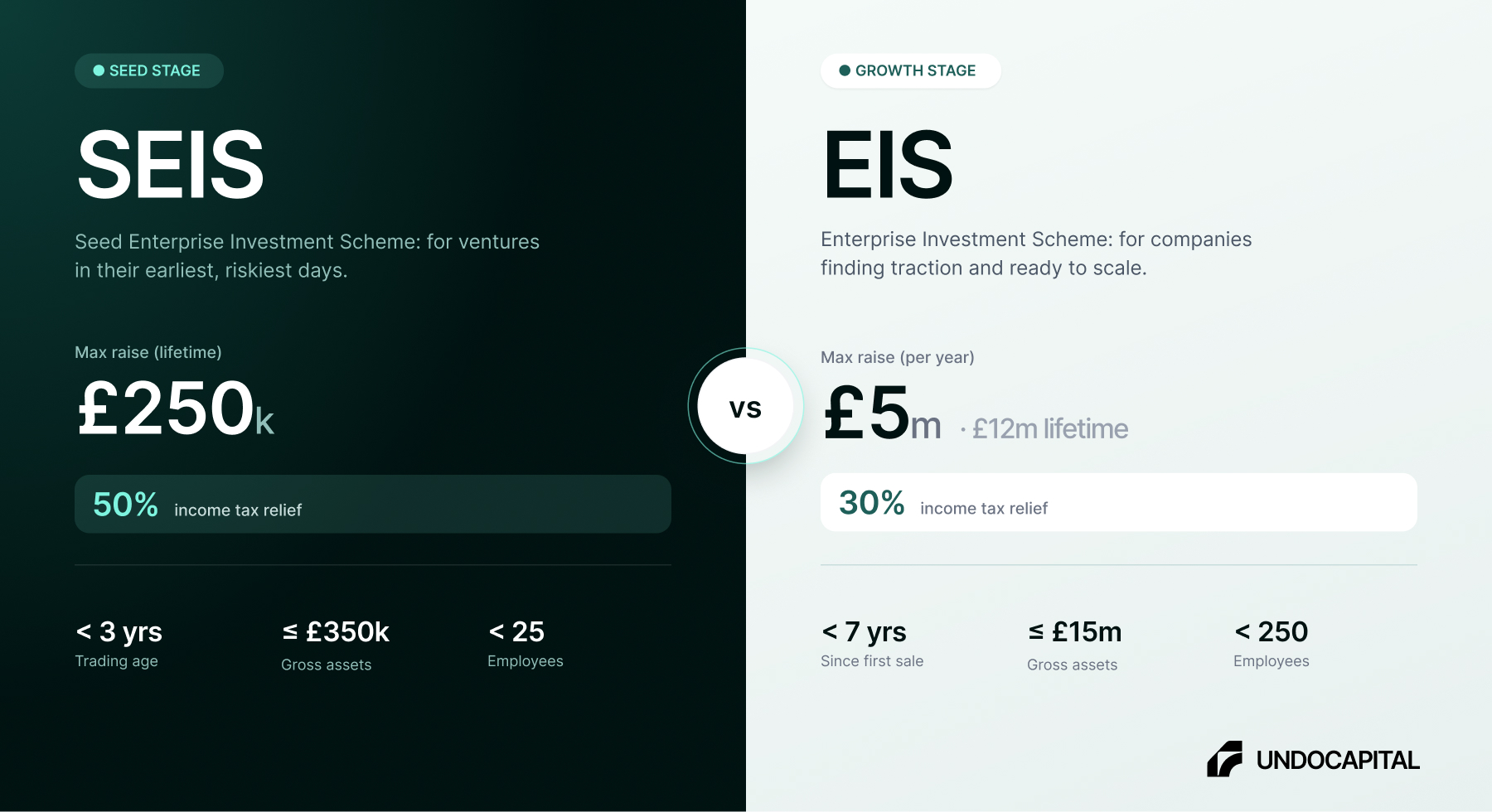
- SEIS suits a trade under three years old: up to £250,000 in total, with 50% income tax relief for investors. EIS covers companies up to seven years from first sale: £10m a year, £24m in total, with 30% relief.
- Most startups use both: SEIS for the first £250,000, then EIS for the rest, allotted on a later day. Same-day issue loses SEIS relief, and once EIS shares exist SEIS is closed.
- Both schemes need ordinary shares paid in cash, an independent unquoted company and unconnected investors; SAFEs and convertible loan notes do not qualify.
SEIS is for companies whose qualifying trade is less than three years old: the company can raise up to £250,000 in total and investors get 50% income tax relief. EIS covers companies up to seven years from their first commercial sale: up to £10m a year and £24m in total, with 30% relief. Most startups use SEIS first, then EIS.
The two schemes work as stages rather than alternatives. Below you will find a side-by-side table, a worked £600,000 round that uses both, the conditions they share, and the order in which to issue shares so that neither relief is lost. Figures use the EIS limits for shares issued from 6 April 2026.
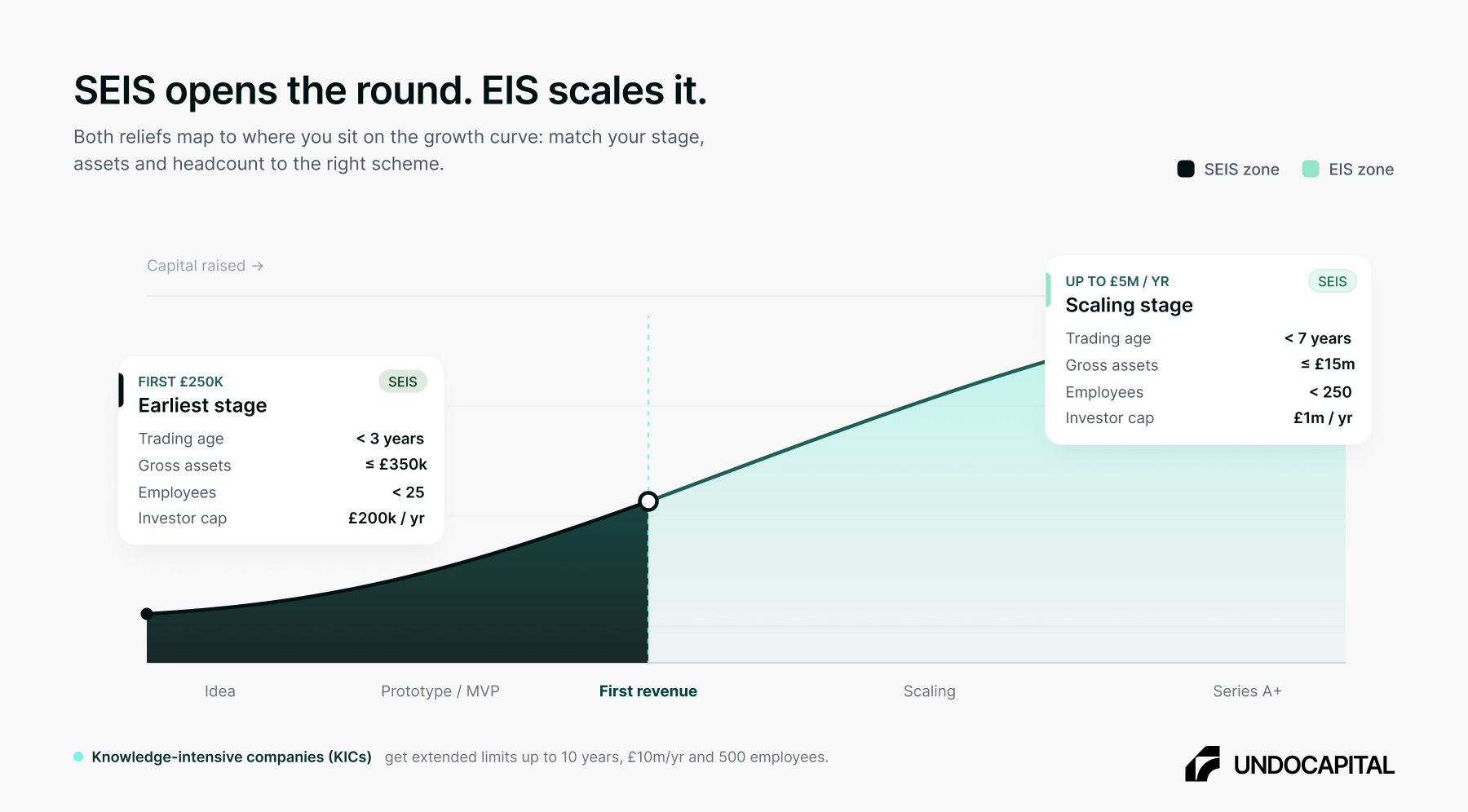
SEIS vs EIS at a glance
The real differences are the company's age and size, how much it can raise and how much relief investors get. Holding period, loss relief and the capital gains tax (CGT) exemption on a sale work the same way under both schemes.
| SEIS | EIS | |
|---|---|---|
| Who it is for | Companies whose qualifying trade started less than 3 years before the share issue | Companies within 7 years of their first commercial sale (10 years for knowledge-intensive companies, KICs) |
| Company raise limit | £250,000 in total | £10m a year and £24m in total (KICs: £20m and £40m) |
| Gross assets | £350,000 or less before the issue | £30m or less before, £35m or less after |
| Employees | Fewer than 25 full-time equivalents | Fewer than 250 (500 for KICs) |
| Investor limit per tax year | £200,000 | £1m (£2m if the excess over £1m goes into KICs) |
| Income tax relief | 50% | 30% |
| Relief on other gains | 50% reinvestment relief on gains invested in SEIS shares | Deferral of gains invested in EIS shares |
| Gain when the shares are sold | CGT-free after 3 years, if income tax relief was given | CGT-free after 3 years, if income tax relief was given |
| Loss relief | Yes, against income or gains | Yes, against income or gains |
| Minimum holding period | 3 years | 3 years |
| Spend the money within | 3 years of the share issue | 2 years of the share issue (or of starting to trade, if later) |
| Compliance statement | SEIS1, after 4 months of trading or once 70% is spent | EIS1, after 4 months of trading |
| Investor certificate | SEIS3 | EIS3 |
| Can follow the other scheme? | No: SEIS is closed once you have issued EIS or VCT shares | Yes: EIS can follow SEIS on a later day |
The higher EIS limits above apply to shares issued on or after 6 April 2026. Before that date the limits were £5m a year, £12m in total and £15m/£16m gross assets. Companies in Northern Ireland trading in goods or electricity keep the old limits. SEIS limits did not change, and the EIS and VCT schemes have been extended to 2035, while SEIS has no end date. Full conditions are in HMRC's guidance on using SEIS and using EIS.
Which scheme should your startup use?
If your company qualifies for SEIS, use it for the first £250,000 and raise anything above that under EIS on a later day. Go straight to EIS only if you no longer meet a SEIS condition or have already raised EIS or VCT money.
- Trade under three years old, gross assets of £350,000 or less, fewer than 25 employees, no earlier EIS or VCT money: SEIS is available. Use it.
- Raising more than £250,000: take the first £250,000 under SEIS and the rest under EIS, in two tranches.
- Close to £350,000 of gross assets or 25 employees: issue the SEIS shares before you cross either threshold, then raise EIS.
- Trade more than three years old, or EIS already used: EIS only.
- More than seven years since your first commercial sale: EIS only if you are a KIC (ten-year window) or the money is for a new product or geographical market and is at least 50% of your average annual turnover over the previous five years.
- Angels writing cheques above £200,000: they can take up to £200,000 under SEIS in a tax year; anything more needs the EIS tranche.
Worked example: a £600,000 round using both schemes
A company that qualifies for SEIS and needs £600,000 issues £250,000 of SEIS shares on one day and £350,000 of EIS shares on a later day. Both tranches can be the same class of ordinary shares at the same price; only the dates differ.
| Tranche | Allotment date | Amount | Shares at £2.00 | Investor income tax relief |
|---|---|---|---|---|
| SEIS | Day 1 | £250,000 | 125,000 | £125,000 (50%) |
| EIS | Day 2 or later | £350,000 | 175,000 | £105,000 (30%) |
| Total | £600,000 | 300,000 | £230,000 |
For an individual angel, the split matters. Suppose an angel puts £60,000 into the round: £40,000 in the SEIS tranche and £20,000 in the EIS tranche. Their income tax relief is £20,000 (50% of £40,000) plus £6,000 (30% of £20,000), so £26,000, and the net cost of the investment is £34,000. Had all £60,000 gone in under EIS, relief would have been £18,000.
Relief is limited to the investor's income tax bill for the year, and the SEIS and EIS investor limits are separate, so the same person can use both in one tax year. Our SEIS and EIS tax relief calculator runs these numbers for any amount.
When SEIS makes more sense
SEIS fits a company with a new trade, a small balance sheet and a first round of £250,000 or less, usually pre-revenue or with its first customers. The 50% relief is what persuades angels to back a company at its riskiest stage.
Typical SEIS companies are building a prototype or MVP, have a founder-only or very small team, and raise from friends, family and first angels who expect the tax relief to soften the downside. £250,000 often funds 12 to 18 months of runway at this stage. Many angels ask whether you are SEIS eligible before they read your deck.
Common SEIS pitfalls
- Failing the independence test: the company must not be controlled by another company, and any subsidiaries must be qualifying subsidiaries (more than 50% owned). A subsidiary that spends the money must be a qualifying 90% subsidiary.
- Crossing a threshold before the issue: a large equipment purchase or a hiring spree can push you over £350,000 of gross assets or 25 employees before the shares are allotted. Time the SEIS issue first.
- Substantial excluded activities: activities such as banking, legal services or property development are fine only if they are not a substantial part of the trade. HMRC normally treats under 20% as not substantial (VCM3010). See our list of qualifying and excluded trades.
- Earlier EIS or VCT money: if the company has ever issued EIS or VCT shares, SEIS is no longer available.
- Using the money for the wrong thing: buying shares in another company or paying out dividends does not count as a qualifying use. Keep records of how the money is spent.
When EIS becomes the better fit
EIS fits once you need more than SEIS allows, your trade is more than three years old, or you have outgrown the £350,000 asset or 25-employee limits. It funds follow-on rounds up to Series A size and beyond.
Typical EIS companies have a product in market and paying customers, and need £1m to £5m to hire a sales team, expand or build infrastructure. EIS also covers the part of a seed round above £250,000, and it lets larger angels and family offices invest with relief on up to £1m a year (£2m with KICs).
Common EIS pitfalls
- Missing the seven-year window: plan the EIS round before seven years have passed since your first commercial sale, unless you are a KIC or meet the new-market rule above.
- Missing the two-year spend window: EIS money must be spent within two years of the share issue, or of the start of trading if later. Match your burn plan to it.
- Paid directors: a paid director can only claim EIS relief under the business angel rules, broadly by investing before becoming a paid director.
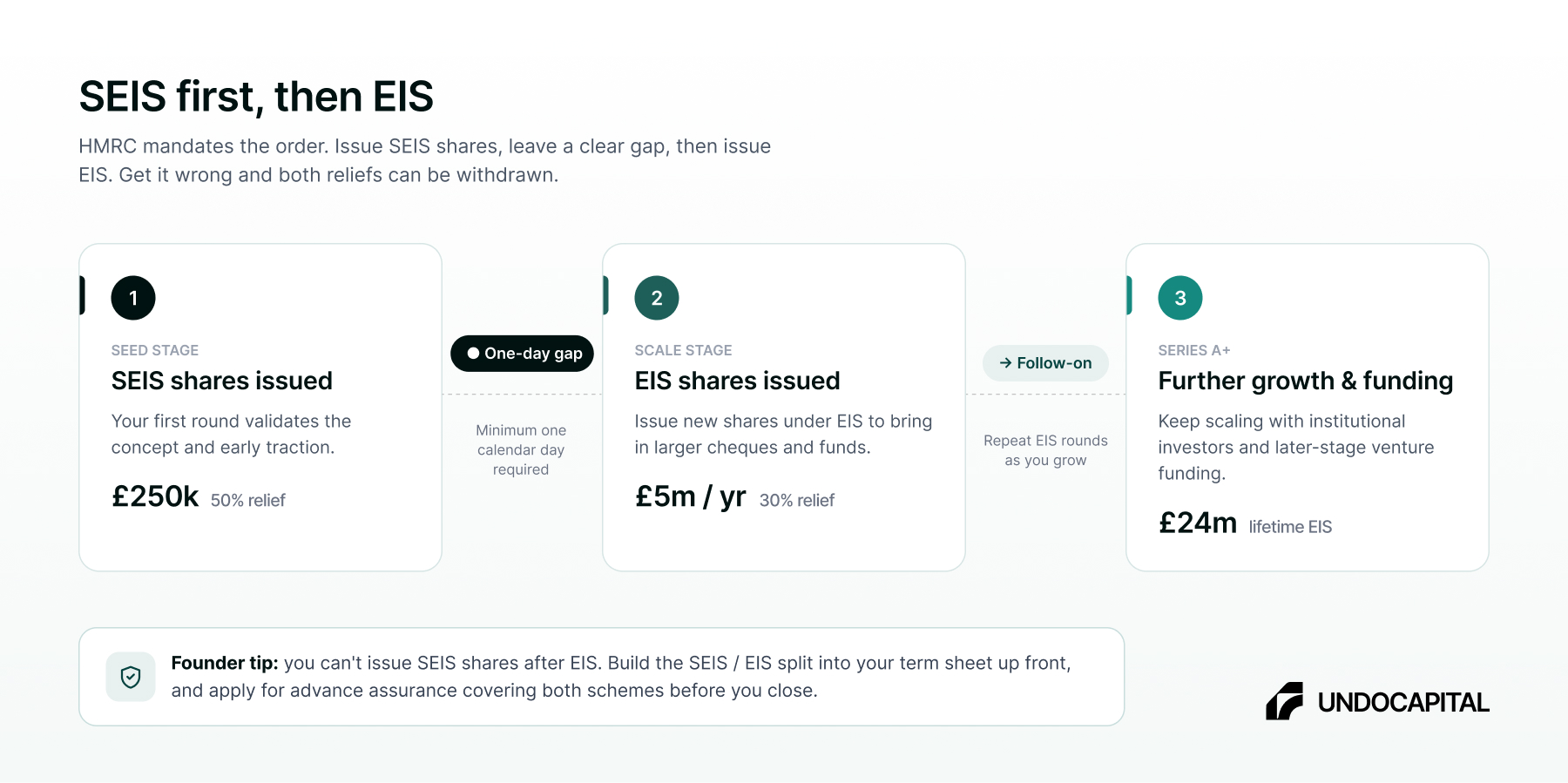
- Issuing EIS before SEIS: once EIS shares are issued, the company can never use SEIS. Settle the SEIS tranche first.
Conditions both schemes share
Both schemes test the company, the shares and the investor. The company must be unquoted, independent and carrying on a qualifying trade; the shares must be new, full-risk ordinary shares paid for in cash; and the investor must not be connected with the company.
Company conditions
- UK permanent establishment: the company must have a permanent establishment in the UK.
- Unquoted: no listing on a recognised stock exchange, and no arrangements in place to become quoted.
- Independent: not controlled by another company, with only qualifying subsidiaries.
- Qualifying trade: excluded activities must not be a substantial part of the business (the 20% guide above). Our guide to SEIS/EIS eligibility criteria covers each test in detail.
- Risk to capital: the company must aim to grow and develop over the long term, and investors' money must be genuinely at risk.
Shares and investors
- The shares: new ordinary shares, fully paid in cash when issued, with no preferential right to assets on a winding up and no redemption rights. SAFEs and convertible loan notes do not qualify. An Advance Subscription Agreement can, if its long-stop date is no more than six months away, it carries no interest, cannot be refunded or varied, and converts into ordinary shares on terms fixed at signing.
- Connection: an investor (with associates, which do not include siblings) must not hold more than 30% of the company. Employees cannot invest with relief. Directors can under SEIS; under EIS, a paid director only qualifies through the business angel rules.
- Holding period: investors must hold the shares for at least three years to keep the relief.
- Other reliefs: shares in qualifying unquoted trading companies may also attract inheritance tax Business Relief after two years, within the current caps. HMRC's guide to tax relief for investors sets out how each relief is claimed.
What you can spend the money on
SEIS money must be spent within three years of the share issue on a qualifying business activity: carrying on a qualifying trade, preparing to carry one on, or R&D expected to lead to one. EIS money must be spent within two years of the share issue, or of the start of trading if that is later. Under both schemes you cannot use the money to buy shares in another company, unless it goes into a qualifying 90% subsidiary that itself uses it for a qualifying activity.
Knowledge-intensive companies (KICs)
KIC status matters for R&D-heavy businesses such as deep tech and life sciences. A KIC must meet the operating-costs condition (at least 15% of costs on R&D or innovation in one of the last three years, or at least 10% in each of them) plus either the innovation condition (creating IP that will form most of its business) or the skilled-employee condition.
In return the company gets a ten-year age window, a 500-employee cap and the higher EIS limits, and investors can claim relief on up to £2m a year if the excess over £1m goes into KICs. You still open with SEIS where you qualify; KIC status makes the EIS stage larger.
Raising through a holding company or subsidiary
You can raise at a UK parent company if the group as a whole meets the size and independence tests, the parent is not controlled by another company, and the group's activities are not substantially excluded trades. If the money will be spent in a subsidiary, that subsidiary must be a qualifying 90% subsidiary (at least 90% of share capital, voting power, profits and assets on a winding up). A simple majority stake is not enough.
State where the money will be used in your Advance Assurance application and again in the SEIS1 or EIS1.
How to sequence SEIS and EIS shares
Issue the SEIS shares on an earlier day than the EIS shares. If both are issued on the same day, SEIS relief is lost (EIS relief is unaffected), and once a company has issued EIS shares it can never use SEIS again.
- Get Advance Assurance for both schemes. One application can cover SEIS and EIS. Name your potential investors.
- Sign the subscription documents and collect the money for each tranche. The two tranches can be the same share class at the same price; separate classes are not required.
- Day 1: allot the SEIS shares. Record the board resolution, update the register of members and issue share certificates within two months of allotment.
- Day 2 or later: allot the EIS shares. Use the real allotment dates in board minutes, the register and the SH01. Never backdate documents to create the gap.
- File an SH01 within one month of each allotment. Our SH01 guide walks through the form. Filing late is an offence for the officers in default, but it does not invalidate SEIS or EIS relief.
- Submit the compliance statements. File SEIS1 once you have traded for four months or spent 70% of the SEIS money, and EIS1 after four months of trading. SEIS1 does not have to be filed before the EIS shares are issued. HMRC then authorises you to issue SEIS3 and EIS3 certificates, which investors use to claim relief.
- Stay compliant for three years. Spend the money within the deadlines, keep records, and tell HMRC within 60 days if something happens that could withdraw relief.
Two records do most of the work here: the allotment dates and the documents behind them. Undo Capital records each tranche as a separate event on a ledger-based cap table, generates a share certificate for each shareholder on every allotment and routes it to the directors for e-signature, and generates the SH01 for you to submit and the SEIS1/EIS1 compliance statements.
Advance Assurance for SEIS and EIS
Advance Assurance is HMRC's optional, non-binding view that a planned share issue should qualify. One application can cover both SEIS and EIS, and HMRC expects you to name potential investors rather than apply speculatively.
It is not a legal requirement, but most UK angels ask for it before they commit. It has no fixed expiry, though it relates to the share issue you described, so a materially different round needs a fresh look. HMRC's Advance Assurance guidance lists what to send, and our step-by-step guide on how to apply for SEIS/EIS Advance Assurance covers the documents and common reasons for rejection.
How Undo Capital handles your Advance Assurance
Whichever scheme fits your stage, the application is where rounds usually stall. In Undo Capital you upload your pitch deck, financial model and other files and answer a few questions; the system drafts the application, and our operators with partner lawyers review it and submit it to HMRC. It can be ready to submit within 24 hours. The Advance Assurance letter itself comes from HMRC. Check your eligibility and start your application.
FAQs
What is the difference between SEIS and EIS?

SEIS is for very young companies: trade under three years old, gross assets of £350,000 or less, fewer than 25 employees, and a £250,000 lifetime raise, with 50% income tax relief for investors. EIS is for companies up to seven years from first commercial sale, raising up to £10m a year and £24m in total, with 30% relief.
Can you use SEIS and EIS in the same round?
Yes. Issue the SEIS shares first and the EIS shares on a later day, even the next day. If both tranches are issued on the same day, SEIS relief is lost while EIS relief is unaffected. The tranches can be the same class of ordinary shares at the same price, and one Advance Assurance application can cover both.
Can an investor claim SEIS and EIS relief in the same tax year?
Yes. The limits are separate: up to £200,000 under SEIS and up to £1m under EIS (£2m if the excess goes into knowledge-intensive companies) in the same tax year. An angel can split one cheque across the SEIS and EIS tranches of a round, getting 50% relief on the first part and 30% on the second.
Can a company raise SEIS after EIS?
No. A company that has issued EIS or VCT shares can no longer use SEIS, so SEIS must always come first. If you might qualify for SEIS, settle that tranche before issuing any EIS shares. Raising EIS on the same day as SEIS also costs you the SEIS relief on that tranche.
Do I need Advance Assurance for SEIS or EIS?
No, it is optional and not binding on HMRC, but most UK angels expect it before investing. One application can cover both schemes. HMRC expects you to name potential investors and describe the planned share issue, along with a business plan, forecasts, cap table and use of funds. The assurance relates to the issue you describe.
References
- GOV.UK: Apply to use the Seed Enterprise Investment Scheme to raise money for your company
- GOV.UK: Apply to use the Enterprise Investment Scheme to raise money for your company
- GOV.UK: Venture capital schemes: tax relief for investors
- GOV.UK: Venture capital schemes: apply for Advance Assurance
- GOV.UK: EIS and VCT investment limit increase and restructure
- GOV.UK: HS393 Seed Enterprise Investment Scheme: income tax and CGT reliefs
- HMRC Venture Capital Schemes Manual: VCM3010, excluded activities
Disclosure Notice: This communication is issued by Undo Capital Limited (“Undo Capital”) and is provided strictly for informational purposes only. It contains general information and should not be relied upon as accounting, business, financial, investment, legal, tax, or other professional advice. Undo Capital is not regulated by the Financial Conduct Authority (FCA) and does not provide investment, financial, or tax advice. Our services are designed to assist startups and businesses with company formation, legal agreements, and funding-related documentation. Nothing in this communication constitutes, or should be construed as, a recommendation, offer, or solicitation to purchase or sell any security or financial instrument.
Participation in startups and early-stage enterprises involves significant risk. Such investments may be illiquid, may not generate dividends, may be subject to dilution, and may result in the total loss of invested capital. Any decisions or actions that may affect your business or personal interests should be taken only after seeking advice from suitably qualified professional advisors, and should form part of a balanced and diversified portfolio. This communication may contain links to third-party websites. The inclusion of such links does not imply endorsement, approval, investigation, or verification by Undo Capital. We accept no responsibility or liability for the content, accuracy, or use of information contained on any third-party websites.
Latest articles

SEIS and EIS tax relief calculator
Founders agreement template UK: what every co-founder should include


