SEIS vs EIS: Which Tax Relief Scheme Is Right for Your Startup (2025 Guide)



.jpg)
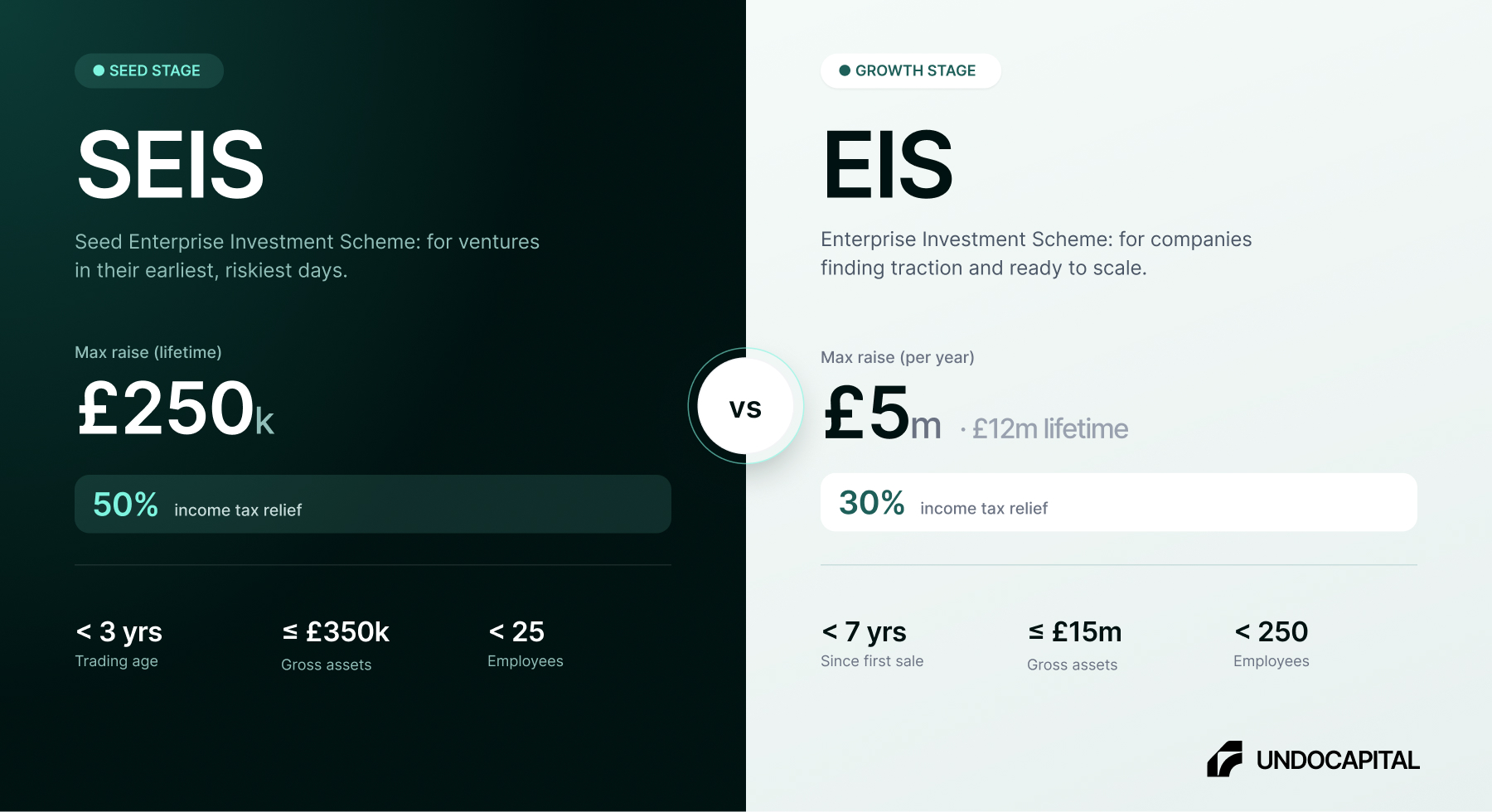
Choosing between the Seed Enterprise Investment Scheme and the Enterprise Investment Scheme is more than an academic exercise. It’s a question of stage, scale and sequencing.Both schemes offer tax‑advantaged funding, but they operate at different points on your growth curve. SEIS suits companies in their earliest days: under three years old, pre‑revenue or just launching and needing up to £250k. EIS picks up when you’re scaling: your product is finding traction, you need up to £10m in any 12-month period (£24m over the company's lifetime), and your headcount and assets have grown. In 2026, the difference between SEIS and EIS continues to matter because limits, investor caps and rules have changed. This guide provides a comprehensive comparison, practical scenarios, and a decision framework to help UK founders and CFOs navigate SEIS vs EIS 2026.
Introduction
For early‑stage entrepreneurs and angel investors, the United Kingdom’s tax‑advantaged venture capital schemes are a lifeline. The Seed Enterprise Investment Scheme (SEIS) and the Enterprise Investment Scheme (EIS) encourage investment by offering income tax, capital gains and losses reliefs when individuals subscribe for new shares in qualifying companies. Both programmes fall under HMRC’s venture capital reliefs, but they are not interchangeable. They serve different types of businesses, impose distinct eligibility conditions and have separate funding caps. Understanding the difference between SEIS and EIS is therefore critical when structuring a seed or seed‑plus round in 2026.
Why revisit this topic now? In April 2023, the government increased the SEIS company cap to £250k and doubled the investor cap to £200k. Meanwhile, EIS has been extended to April 2035, with investor allowances of £1 million per year (up to £2 million for knowledge‑intensive company investments). Startups are operating in a cautious funding environment where valuations are scrutinised and founders must demonstrate a clear understanding of the tax schemes they rely on. SEIS vs EIS 2026 is not about labels; it’s about aligning your stage of growth with the right mechanism, sequencing them correctly and communicating the strategy to investors.
This comprehensive guide breaks down SEIS and EIS for 2026. We begin with a quick summary and a table that captures the headline differences. Then we explore when each scheme makes sense, typical scenarios founders face, common pitfalls and how to sequence the schemes across multiple rounds. The SEIS, EIS comparison continues with eligibility snapshots, decision checklists, mini‑cases and process overviews. Finally, we answer frequently asked questions and provide soft calls‑to‑action so you can evaluate your eligibility and streamline your raise with Undo Capital.
SEIS vs EIS at a Glance
At a glance, SEIS and EIS differ in company age, size, funding caps and investor allowances. SEIS is deliberately narrow. The investor must hold shares for at least 3 years to keep the income tax relief and benefit from the CGT exemption. EIS is broader, targeting businesses up to seven years old (ten years for knowledge‑intensive companies) with higher asset and employee limits. The funding you raise under SEIS counts toward your EIS cap, and both programmes require you to spend the money on qualifying trades or R&D within specified periods.
When SEIS Makes More Sense
The Early‑Stage Sweet Spot
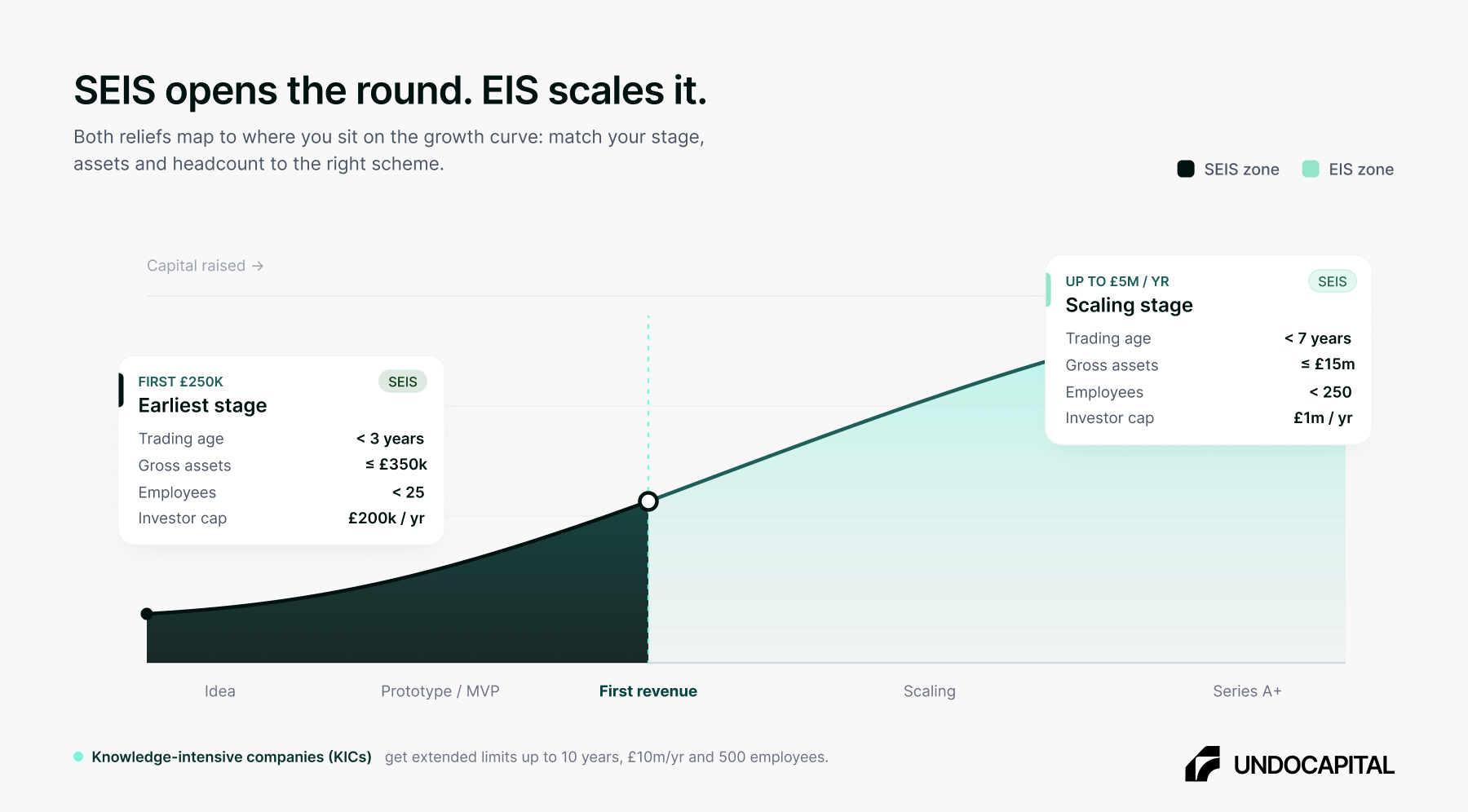
SEIS is your opening act. It is built for ventures that are still sharpening prototypes, finalising MVPs or turning a handful of customers into a viable business. To qualify, you must have been trading for fewer than three years, hold gross assets of no more than £350k and employ fewer than 25 full‑time equivalents. Companies cannot have previously raised funds under EIS or from a Venture Capital Trust. This structure ensures that SEIS targets the riskiest part of the startup journey, the moment when the idea is fragile and capital is scarce.
From the investor’s perspective, SEIS offers generous incentives. Individuals can subscribe up to £200k per tax year and receive income tax relief on the investment. If the company succeeds, any capital gains on those shares are exempt after they have been held for three years. If it fails, investors may offset losses against income or capital gains. For angels who invest in very early businesses, this downside protection matters. It is why many angels ask, “Are you SEIS eligible?” before they even see your deck. In 2025, the higher company cap of £250k means you can raise more under SEIS than before, making it a realistic route to a 12–18‑month runway.
Typical SEIS Scenarios Founders Face
- Pre‑product or prototype stage: You have built a minimal product or are still in R&D. Revenue is either non‑existent or negligible. You need £100k–£250k to hire engineers, test market fit and build your first customer base. You may still be working part‑time elsewhere, and your cap table is mostly founders.
- Family, friends & first angels: Your earliest investors are individuals, friends, family or angels, who want to support your vision but expect a safety net. They are comfortable with high risk if there is potential for high return, but only if the tax relief reduces their downside. SEIS’s income tax and reinvestment relief is designed for this.
- Limited traction, lean team: You have fewer than 25 employees. Your asset base is light, often limited to laptops and prototypes. You are not yet scaling; your focus is product and market validation. SEIS encourages investors to support you at this stage.
Common Pitfalls When Aiming for SEIS
- Failing the independence test: Your company must not be controlled by another company and must not own more than 50% of another company unless that subsidiary is a qualifying 90% subsidiary. Founders sometimes inadvertently breach this by setting up complex holding structures.
- Exceeding the asset or employee caps before the raise: Signing a lease or purchasing equipment that pushes assets above £350k, or hiring aggressively before the funding round, can disqualify you. Plan your growth so that the share issue happens before hitting these thresholds.
- Mixing trades or excluded activities: HMRC maintains a list of excluded trades (such as banking, legal services or property development). Even ancillary excluded activities can render your whole company ineligible. Understand qualifying trades and ensure your core revenue comes from them.
- Mismanaging use of funds: SEIS money must be spent within three years on a qualifying trade, preparatory activities or R&D. Spending on buying another business, paying founder dividends or acquiring non‑qualifying assets will jeopardise investor relief. Keep receipts and use separate bank accounts if possible.
When EIS Becomes the Better Fit
Moving from Concept to Scaling
Once you have shipped a product, won paying customers and started to grow headcount, SEIS’s tight limits become constraining. EIS is designed for companies that need larger rounds to scale. To qualify, your company must be established within seven years of its first commercial sale (ten years for a knowledge‑intensive company (KIC). Your gross assets can be up to £30 million before the investment and £35 million immediately after, and you can have up to 250 employees (500 for KICs). These thresholds reflect the demands of scaling teams and infrastructure.
EIS allows companies to raise up to £10 million per year and £24 million lifetime. A knowledge‑intensive company, typically deep‑tech or life sciences, can raise up to £20 million per year and £40 million in total. Investors can subscribe up to £1 million per year (or £2 million if at least £1 million goes into KICs) and receive income tax relief; they may also defer capital gains by reinvesting gains in EIS shares. Loss relief applies, and shares must be held for at least three years to retain relief.
Typical EIS Scenarios for Scaling Rounds
- Post‑revenue, scaling operations: You have a product in the market, paying customers and metrics. You need £1–5 million to hire a sales team, invest in marketing, expand into new regions or build infrastructure. EIS investor caps make these cheques possible.
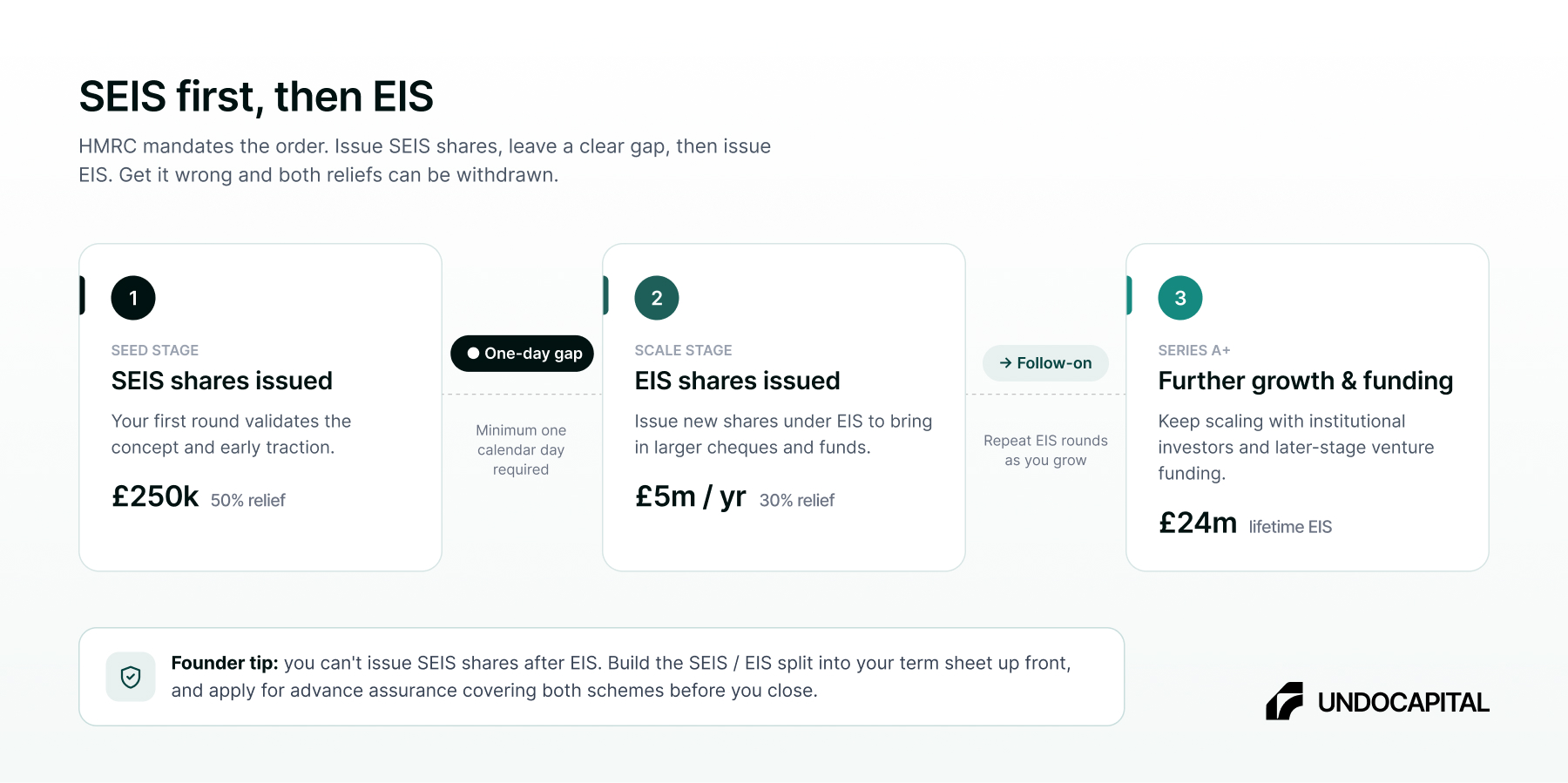
- Follow‑on rounds after SEIS: You raised under SEIS, spent the funds, and now require additional capital. EIS lets you bring in institutional investors, family offices and later‑stage angels. Note that SEIS shares must be issued first; you cannot issue SEIS after EIS.
- Knowledge‑intensive companies (KICs): Deep‑tech startups, biotech ventures or R&D‑heavy businesses often have longer development cycles. KIC status allows for larger investor limits and a ten‑year age window. To qualify, you must meet R&D expenditure or skilled‑employee thresholds.
Common Pitfalls When Switching to EIS
- Ignoring the seven‑year rule: If your company is more than seven years from its first commercial sale and you are not a KIC, you may be ineligible for EIS unless the round introduces a new product/market and represents at least 50% of your five‑year average turnover. Plan your EIS raise before time runs out.
- Overlooking subsidiary conditions: If funds will be deployed in a subsidiary, that company must be a qualifying 90% subsidiary (≥90% of shares, voting rights and profits). Failure to meet this can void relief.
- Failing the two‑year spend window: EIS funds must be spent within two years of the investment or the start of trading. Use-of-funds rules are stricter than SEIS; make sure your burn plan matches.
- Director involvement: Paid directors cannot claim EIS relief unless they meet the “business angel” conditions (investing first and then becoming a director). Ensure investors understand these rules.
Eligibility Snapshot: What Qualifying Looks Like
Eligibility involves more than a few numbers. HMRC checks the company’s status, the nature of its trade and the investor’s relationship to the business. Here is a high‑level overview; for detailed requirements, see our internal guide SEIS/EIS Eligibility Criteria Explained for Founders.
Company Conditions
- Permanent establishment in the UK: Your company must be incorporated in the UK or have a permanent establishment here.
- Unquoted status: You cannot be trading on a recognised stock exchange at the time of the share issue and must not plan to do so. SEIS also prohibits companies that have arrangements to become a quoted company or to become a subsidiary of a quoted company.
- Independence: Your company cannot be controlled by another company and cannot control another company except for qualifying subsidiaries. Subsidiaries used for qualifying activities must be 90% subsidiaries.
- Asset and employee tests: SEIS requires gross assets ≤ £350k and fewer than 25 employees. EIS allows gross assets up to £30 million before investment and ≤ £35 million after, and up to 250 employees (500 for KIC).
- Trading history: Under SEIS, the trade must not have been carried on for more than three years. For EIS, the company generally must raise within seven years of its first commercial sale.
- Qualifying trade: Both schemes exclude certain trades (banking, financial services, dealing in land/commodities, legal services, property development, energy generation and more). At least 80% of activities must be qualifying. Consult HMRC guidance or professional advisors for details.
Qualifying Trades
A qualifying trade is any activity that aims to generate profits through goods or services, but it must not fall into HMRC’s excluded activities. Relief is jeopardised if excluded activities become substantial. Research and development count as a qualifying use of funds as long as it is expected to lead to a qualifying trade. Because the risk‑to‑capital condition applies to both schemes, HMRC will look at whether your company intends to grow and develop over the long term and whether investors’ capital is genuinely at risk.
Investor Considerations
- Residence and connection: Investors need not be UK residents, but they must pay UK income tax to benefit fully from relief. They cannot be employees of the company (though unpaid directors may qualify under EIS)
- Stake limits: Investors cannot own more than 30% of the company’s voting rights or control it via other means. Connected persons (family, partners) also count towards this limit. This ensures SEIS and EIS remain focused on external investors.
- Subscription for new ordinary shares: Shares must be newly issued, fully paid up in cash and carry no preferential rights to dividends or repayment. Loan notes, redeemable shares or preference shares do not qualify.
How to Sequence SEIS and EIS Across Rounds
Sequencing is not optional; it is mandated by HMRC. The general rule is SEIS before EIS. Your first £250k should be issued as SEIS shares, and any additional capital should be issued under EIS at least one day later. Mixing them or issuing both tranches on the same day risks both reliefs being withdrawn.
Example Sequencing for a 12–18‑Month Runway
- Pre‑round planning: Determine how much of your round will qualify under SEIS (up to £250k) and how much will fall under EIS. Forecast your cash burn and ensure the SEIS funds will be used within three years and the EIS funds within two. Build this split into your deck and term sheet.
- Advance assurance: Apply for advance assurance covering both schemes to reassure investors. Submit your business plan, financial forecasts, details of qualifying trades, planned use of funds and prospective investors. HMRC’s response is non‑binding but signals whether your proposal would likely qualify.
- Issue SEIS shares: Once you close commitments, issue SEIS shares first. File form SEIS1 after you have been trading for four months or have spent 70 % of the money. HMRC will respond with SEIS2/SEIS3 certificates that investors use to claim relief.
- One‑day gap: Wait at least one calendar day before issuing EIS shares. This gap can be represented by dating share certificates appropriately if the transactions happen close together. The key is to show clear sequencing.
- Issue EIS shares: After the gap, issue EIS shares for the remaining amount. File form EIS1 when you have carried on the qualifying activity for at least four months. HMRC will issue EIS2/EIS3 certificates.
Post‑round compliance: Track the use of SEIS and EIS funds separately. Keep detailed records of spend, employees and activities. If anything changes (e.g., new investors, a change in trade), inform HMRC within 60 days.
Coordinating Term Sheets, Share Issues and Compliance
A common mistake is to treat SEIS and EIS as line items rather than integrated parts of a round. You should build the SEIS/EIS split into your term sheet, specifying the number of shares, price per share and expected relief for each tranche. Investor communications should clarify that SEIS shares will be issued first, followed by EIS shares. The cap table must reflect this sequencing; if you use spreadsheets, errors creep in. Undo Capital’s platform automates these tasks: it allocates shares, generates term sheets and ensures compliance filings happen in the right order. Use automation to reduce administrative burden and avoid expensive mistakes.
Decision Guide: Choose SEIS or EIS for 2026
Choosing between SEIS and EIS, or choosing how to combine them, comes down to an honest assessment of your company’s stage, funding needs and investor profile. Use the following checklist to guide your decision:
- Age of your company: If you have been trading for less than three years, SEIS is available; beyond that, EIS becomes your primary scheme.
- Amount you need to raise: If your round is under £250k and you meet SEIS conditions, use SEIS. For rounds above that, split the first £250k under SEIS and the remainder under EIS.If you need more than £10 million in a 12‑month period or £24 million lifetime you may need to explore other sources or qualify as a KIC.
- Asset base and headcount: Check your gross assets and number of employees. If you’re nearing £350k in assets or 25 employees, consider raising under EIS sooner rather than later.
- Investor profile: Do your investors typically write cheques under £200k? If so, SEIS may suffice. If your investor base includes family offices or venture funds that want to invest £500k–£2m, EIS will be essential to provide relief.
- Qualifying trade: Confirm that your activity is a qualifying trade and that less than 20% of turnover comes from excluded activities. If you operate in regulated or excluded sectors, you may not qualify.
- Forward fundraising plans: Are you planning follow‑on rounds? Using SEIS first preserves EIS for later rounds and signals a clear growth trajectory. Issuing EIS first closes the door on SEIS; you cannot return to SEIS.
- Knowledge‑intensive company status: If you invest heavily in R&D and employ highly qualified staff, you may qualify for KIC status, which extends time and funding limits. This can make EIS more attractive.
- Risk‑to‑capital compliance: Ensure that your business plan shows real risk and growth potential. HMRC’s risk‑to‑capital condition requires your company to have long‑term objectives to grow, and for investors’ capital to be at risk.
Readiness for compliance: Consider whether you have the capacity to manage compliance statements, investor communications and record‑keeping. SEIS is simpler but still demands rigour; EIS is more complex and benefits from automation.
Process Overview: From Choice to Advance Assurance
Once you decide on your scheme or combination, you must navigate the HMRC process. The steps are similar for SEIS and EIS, but there are nuances.
- Determine your eligibility: Check age, asset and employee tests, and ensure your trade is qualifying.
- Prepare your documentation: HMRC requires detailed information: how much you plan to raise; business plan and financial forecasts; use‑of‑funds breakdown; latest accounts; company constitution; cap table; and details of potential investors. Having these ready speeds up the process.
- Submit advance assurance: Advance assurance is a non‑binding opinion from HMRC that your proposed share issue would likely qualify. Though not mandatory, most sophisticated investors insist on it. Apply via the online form, upload supporting documents and respond promptly to HMRC queries.
- Close your round and issue shares: Once you have investor commitments, issue SEIS shares first, then EIS shares after at least one day. Use a platform like Undo Capital to auto‑generate share certificates, investment agreements and board consents, ensuring that sequencing is documented.
- File compliance statements: After you have either traded for four months or spent 70% of SEIS funds, file SEIS1. For EIS, file EIS1 after four months of trading. HMRC will issue SEIS2/EIS2 authorisations and SEIS3/EIS3 certificates for investors.
- Maintain compliance: Spend the money on qualifying activities within the deadlines. Maintain records of use of funds, employee numbers, trading activities and shareholdings. Report any changes (e.g., sale of shares, cessation of trade) to HMRC within 60 days.
How Undo Capital handles your Advance Assurance
Whichever scheme fits your stage, most UK investors will want HMRC Advance Assurance before they commit, and getting it right is where rounds usually stall. Undo Capital handles the whole process, from eligibility to HMRC submission. You can check your eligibility for free or read the full SEIS/EIS Advance Assurance guide before you start.
FAQs
What’s the main difference between SEIS and EIS in 2025?

SEIS supports very early-stage startups trading for under three years, with assets below £350k and fewer than 25 employees. You can raise up to £250k. EIS suits more mature businesses trading up to seven years (ten for knowledge-intensive), with assets up to £30 million and up to 250 staff.
Can a startup use SEIS first and EIS later?
Yes. Founders often raise their first £250k under SEIS, then switch to EIS once those shares are issued (after at least one day). This sequencing maximises investor relief and broadens funding options. You can’t issue SEIS shares after EIS.
Which scheme is better for seed-stage investors?
SEIS offers higher tax and loss reliefs, ideal for early-stage investors, but limits each investor to £200k a year. Angels wanting to invest more can combine SEIS and EIS, taking £200k under SEIS and the rest via EIS.
Do SEIS and EIS cover all trades?
No. Excluded sectors include banking, insurance, property development, energy generation and similar activities. A qualifying company must earn most of its income from eligible trades. Incidental excluded activities (under 20% of turnover) are acceptable.
Do I need advance assurance before fundraising?
It’s not mandatory but strongly advised; most investors expect it. Advance assurance shows HMRC’s initial approval and boosts investor confidence. It requires submitting your plan, forecasts, cap table and potential investors. Update HMRC if your details change.
References
- GOV.UK — Venture Capital Schemes: Tax Relief for Investors
- GOV.UK — Apply to Use the Seed Enterprise Investment Scheme (SEIS)
- GOV.UK — SEIS Eligibility: Trading and Partnership Rules
- GOV.UK — HMRC Helpsheet HS393: SEIS Income Tax and Capital Gains Tax Reliefs (2025)
- GOV.UK — SEIS Guidance: When Shares Are Issued
- Apply for the Enterprise Investment Scheme (EIS)
- Money.co.uk — Is SEIS and EIS Right for My Business?
- GOV.UK (HMRC Manual) — Venture Capital Schemes Manual: VCM3010
Disclosure Notice: This communication is issued by Undo Capital Limited (“Undo Capital”) and is provided strictly for informational purposes only. It contains general information and should not be relied upon as accounting, business, financial, investment, legal, tax, or other professional advice. Undo Capital is not regulated by the Financial Conduct Authority (FCA) and does not provide investment, financial, or tax advice. Our services are designed to assist startups and businesses with company formation, legal agreements, and funding-related documentation. Nothing in this communication constitutes, or should be construed as, a recommendation, offer, or solicitation to purchase or sell any security or financial instrument.
Participation in startups and early-stage enterprises involves significant risk. Such investments may be illiquid, may not generate dividends, may be subject to dilution, and may result in the total loss of invested capital. Any decisions or actions that may affect your business or personal interests should be taken only after seeking advice from suitably qualified professional advisors, and should form part of a balanced and diversified portfolio. This communication may contain links to third-party websites. The inclusion of such links does not imply endorsement, approval, investigation, or verification by Undo Capital. We accept no responsibility or liability for the content, accuracy, or use of information contained on any third-party websites.
Latest articles
SEIS and EIS Tax Relief Calculator
Founders Agreement Template UK: What Every Co-Founder Should Include