Shareholder Register UK: What It Is, What Must Be Included, and How to Maintain It



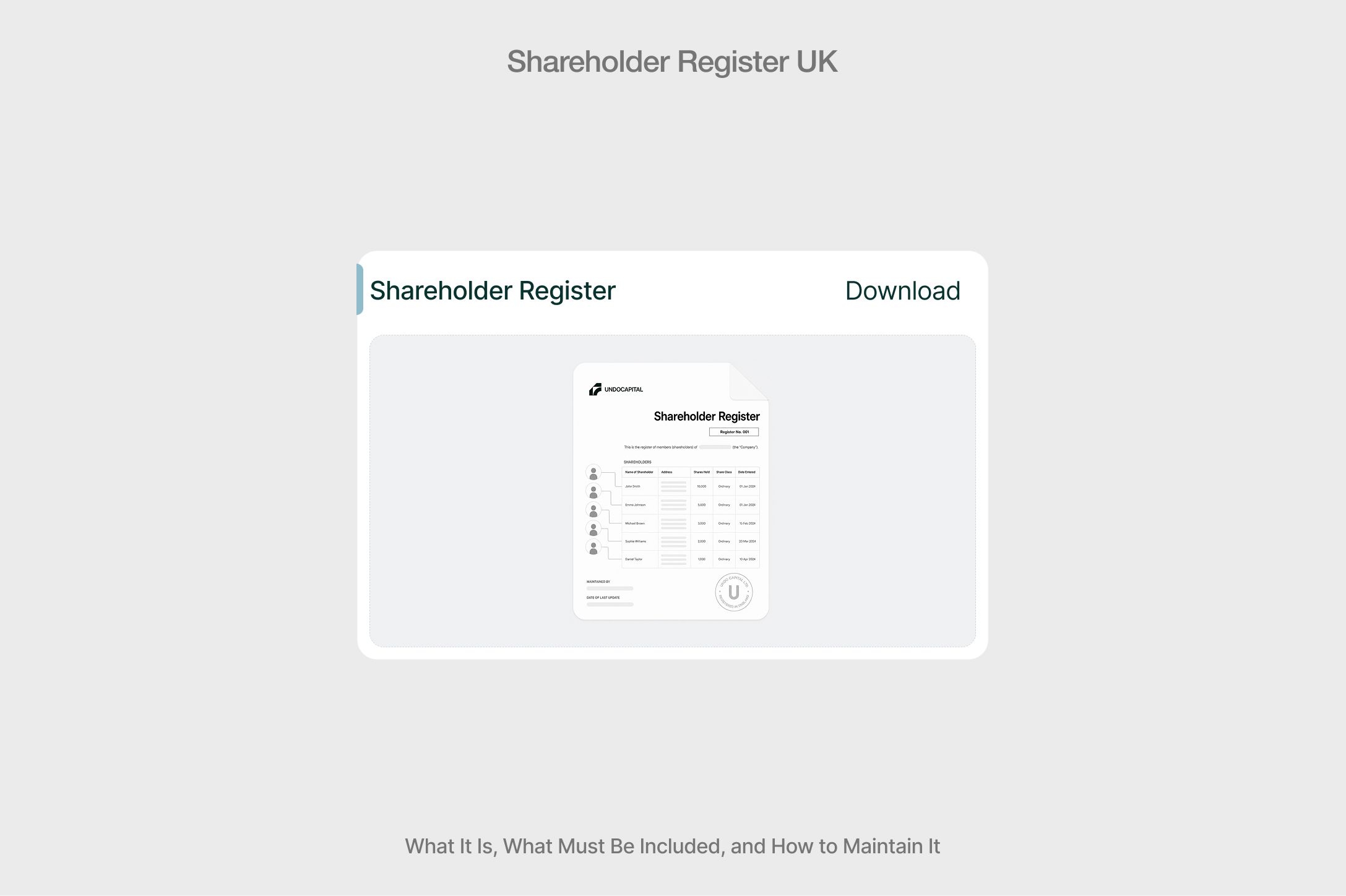
- A shareholder register (the law calls it the register of members) is your company's official record of who owns its shares. Every UK company must keep one. Skip it, and you and your officers commit an offence under the Companies Act 2006, with a fine on conviction.
- It must hold set details: each member's name and address, the date they joined, the date they left, and the number, class, and amount paid on their shares. Missing fields make the register non-compliant.
- The hardest part is not creating it. It's keeping it accurate after every share issue, transfer, or cancellation, and keeping it in sync with your annual confirmation statement at Companies House.
A shareholder register is the official, legally required record of who owns shares in a UK company. Under the Companies Act 2006, every company must keep one from the day it's incorporated. It lists each shareholder, the shares they hold, and the dates they became or stopped being a member. It is not a nice-to-have spreadsheet. It is a statutory register, and getting it wrong carries real legal and financial cost.
Most founders meet the share register the moment they raise money or grant equity, then realise nobody has kept it current. This guide fixes that. It covers what the law demands, what the document must include, where to keep it, and how to maintain it without it falling out of date.
What is a shareholder register?
A shareholder register is the book or record in which a company records its members and their shareholdings. "Member" is the legal word for shareholder. When you own shares, and your name is entered in this record, you become a member of the company. The register is the proof.
This is why it matters so much. Your name being on a share certificate feels like ownership, but the certificate is only evidence. Legal title flows from the entry in the register of members. If the two ever disagree, the register usually wins. That single fact is why a sloppy shareholder registry causes disputes during fundraising and acquisition.
Shareholder register, share register, register of members, are they the same thing?
Yes. In the UK, these terms all describe one statutory record.
- The register of members is the formal term used in the Companies Act 2006.
- Shareholder register and share register are the everyday plain-English versions.
- You'll also see shareholder registry, shareholders register, and record of shareholders used loosely for the same document.
They are interchangeable. A buyer's lawyer doing due diligence and a founder updating a spreadsheet are talking about the same thing. The law's word is "register of members"; everyone else tends to say "shareholder register."
Why every UK company must keep one
Section 113 of the Companies Act 2006 requires every company to keep a register of members. This is not optional and does not depend on size. A single-director, single-shareholder company has the same duty as a venture-backed scale-up.
The penalty has teeth. If a company fails to keep the register, the company and every officer in default commit an offence. On conviction, the punishment is a fine, and for a continuing breach, a daily default fine on top. In short, an out-of-date share register is not just untidy. It is a breach of the law.
What must a shareholder register include?
The required contents come straight from section 113. Use the checklist below. Each field maps to the statute, so you can see exactly why it's there.
If the contents page is missing any of these, the register is incomplete. A common failure is recording the shareholder but not the class of shares once a priced round introduces preference shares. That gap surfaces during the next raise, when an investor's lawyer asks for a clean record of shareholders, and you can't produce one.
Details for each member
Record the member's full legal name, not a nickname or a trading name, and a usable address. For corporate shareholders, that's the company name and registered office. Joint holders are entered together against the relevant shareholding.
Information about the shares held
State the number and class of shares for each holder, and the amount paid up. If your company has only ordinary shares, the class is simple. The moment you create preference shares, growth shares, or a separate founder class, every entry must name the class. This is where registering shares correctly during a round protects you later.
Dates of becoming and ceasing to be a member
The register is a history, not a snapshot. When someone joins, record the date. When they transfer or sell all their shares and leave, record the date they ceased to be a member. Keep the old entries. A buyer wants to trace the full chain of ownership, and a register that only shows today's position fails due diligence.
Where and how to keep your shareholder register
You have choices about location, but not about keeping it accessible.
Keeping it at your registered office or a SAIL address
By default, the register of members lives at your registered office. You can instead keep it at a single alternative inspection location, known as a SAIL address, as long as it's in the same part of the UK where the company is registered. You must tell Companies House where it's held. The format can be a bound book or an electronic record, but it must be capable of being inspected.
The single-entry central register option
Since June 2016, private companies can elect to keep their membership information on the public register at Companies House instead of maintaining their own internal register. This is the "central register" option under section 128B. It can simplify life for very small companies. But it makes shareholder names and addresses publicly searchable, which many founders dislike. Most growing companies keep their own share register for control and privacy.
Inspection rights: who can see your share register
The register isn't private to the directors. Under sections 116 to 117, members can inspect it for free, and anyone else can inspect it on payment of a fee, provided the request is for a "proper purpose." A company can refuse an improper request, but only by applying to court within five working days. Members are also entitled to a copy. So your shareholders' register must be ready to show, not buried in an inbox.
How to maintain a shareholder register
This is where most registers fail. Creating one is a day's work. Keeping it correct is the ongoing duty.
Recording a share issue or transfer
Every share event changes the register, and the change must be entered promptly.
- New share issue. When you allot new shares, enter the new member (or add to an existing holding), the date, the number and class, and the amount paid. For a transfer, the law requires the company to enter the transfer "as soon as practicable" once a valid transfer is lodged.
- Transfer between shareholders. Mark the seller's shares as transferred, record the date they ceased to hold them, and enter the buyer with their new holding. Update both sides in one go.
- Cancellation or buyback. Record the reduction and the date.
The discipline of share registration at the moment of the event, not months later, is what keeps the document trustworthy.
Keeping it in sync with your confirmation statement (CS01)
Once a year, your company files a confirmation statement (form CS01) at Companies House. The first confirmation statement after any change in shareholders or share capital must report it. Your internal register and your CS01 must tell the same story. When they don't, you get the classic mismatch: Companies House shows one cap table, your register shows another, and an investor finds the gap during diligence. Reconcile the two before you file, every time.
Common mistakes that make a register non-compliant
A few errors come up again and again:
- Updating the cap table but not the register. A modelling spreadsheet is not the statutory record. Both must move together.
- Forgetting to share class after a priced round introduces preference shares.
- Deleting historic members instead of marking the date they ceased. History is part of the record.
- Letting the register and CS01 drift apart over several rounds.
Each looks minor. Stacked over three or four years and several rounds, they create the kind of messy ownership history that slows a deal or knocks value off it. Untangling a neglected register during a transaction routinely costs thousands of pounds in advisory fees, and the founder pays it under deal pressure.
Shareholder register template vs a live cap table
Plenty of founders start with a document, and that's a fine first step.
A free template gets you started
A shareholder register template gives you the right columns from day one. Search, and you'll find a share register template, a sample share register, or a register of members template in seconds. Each is a simple table built around the section 113 fields. For a company with one or two founders and no funding, that's enough.
Why a manual template breaks as you grow
The trouble starts after the first real round. A template is a static file. Every share issue, transfer, option exercise, and CS01 filing is a manual edit. Miss one, and the register quietly drifts from reality. With ten shareholders across two share classes, the chance of human error climbs fast.
This is why many UK founders move from a manual template to a live cap table, where the register, the cap table, and the share certificates all update from the same source whenever a share event happens. Undo Capital is built around exactly this: the cap table and the shareholders hub keep the statutory record and the live ownership picture in step, so the register doesn't fall behind the company. The template gets you started; a connected system keeps you compliant as the share register grows.
Note: This article is general information, not legal advice. Confirm your specific obligations with a qualified adviser or Companies House guidance.
FAQs
What is a shareholder register?

A shareholder register, also called a share register or statutory register of members, is the official record of who owns shares in a UK company. Under the Companies Act 2006, every UK company must keep one. It lists each shareholder's details, the number and class of shares they hold, and the dates they became or stopped being a member.
Is a shareholder register the same as a register of members?
Yes. In the UK, "shareholder register," "share register," and "register of members" all refer to the same statutory record required under the Companies Act 2006. "Register of members" is the formal legal term; the others are the common plain-English versions.
What must be included in a UK shareholder register?
Each member's name and address, the date they became a member, the date they ceased to be a member if applicable, the number and class of shares held, and the amount paid or agreed to be paid on those shares. Keeping these accurate and current is a legal requirement under section 113.
Where must a company keep its shareholder register?
At its registered office or at a single alternative inspection location (SAIL) address. Private companies can instead elect to keep the information on the central register at Companies House. Either way, members and others with a proper purpose have a legal right to inspect it.
How do you maintain a shareholder register?
Update it every time shares are issued, transferred, or cancelled, and keep it consistent with your annual confirmation statement (CS01) at Companies House. Many UK founders now keep theirs as a live cap table, so every share event updates the register automatically.
References
Disclosure Notice: This communication is issued by Undo Capital Limited (“Undo Capital”) and is provided strictly for informational purposes only. It contains general information and should not be relied upon as accounting, business, financial, investment, legal, tax, or other professional advice. Undo Capital is not regulated by the Financial Conduct Authority (FCA) and does not provide investment, financial, or tax advice. Our services are designed to assist startups and businesses with company formation, legal agreements, and funding-related documentation. Nothing in this communication constitutes, or should be construed as, a recommendation, offer, or solicitation to purchase or sell any security or financial instrument.
Participation in startups and early-stage enterprises involves significant risk. Such investments may be illiquid, may not generate dividends, may be subject to dilution, and may result in the total loss of invested capital. Any decisions or actions that may affect your business or personal interests should be taken only after seeking advice from suitably qualified professional advisors, and should form part of a balanced and diversified portfolio. This communication may contain links to third-party websites. The inclusion of such links does not imply endorsement, approval, investigation, or verification by Undo Capital. We accept no responsibility or liability for the content, accuracy, or use of information contained on any third-party websites.
Latest articles


SEIS and EIS Tax Relief Calculator

Founders Agreement Template UK: What Every Co-Founder Should Include