UK investment tax reliefs explained: EIS, SEIS & VCT changes for 2026



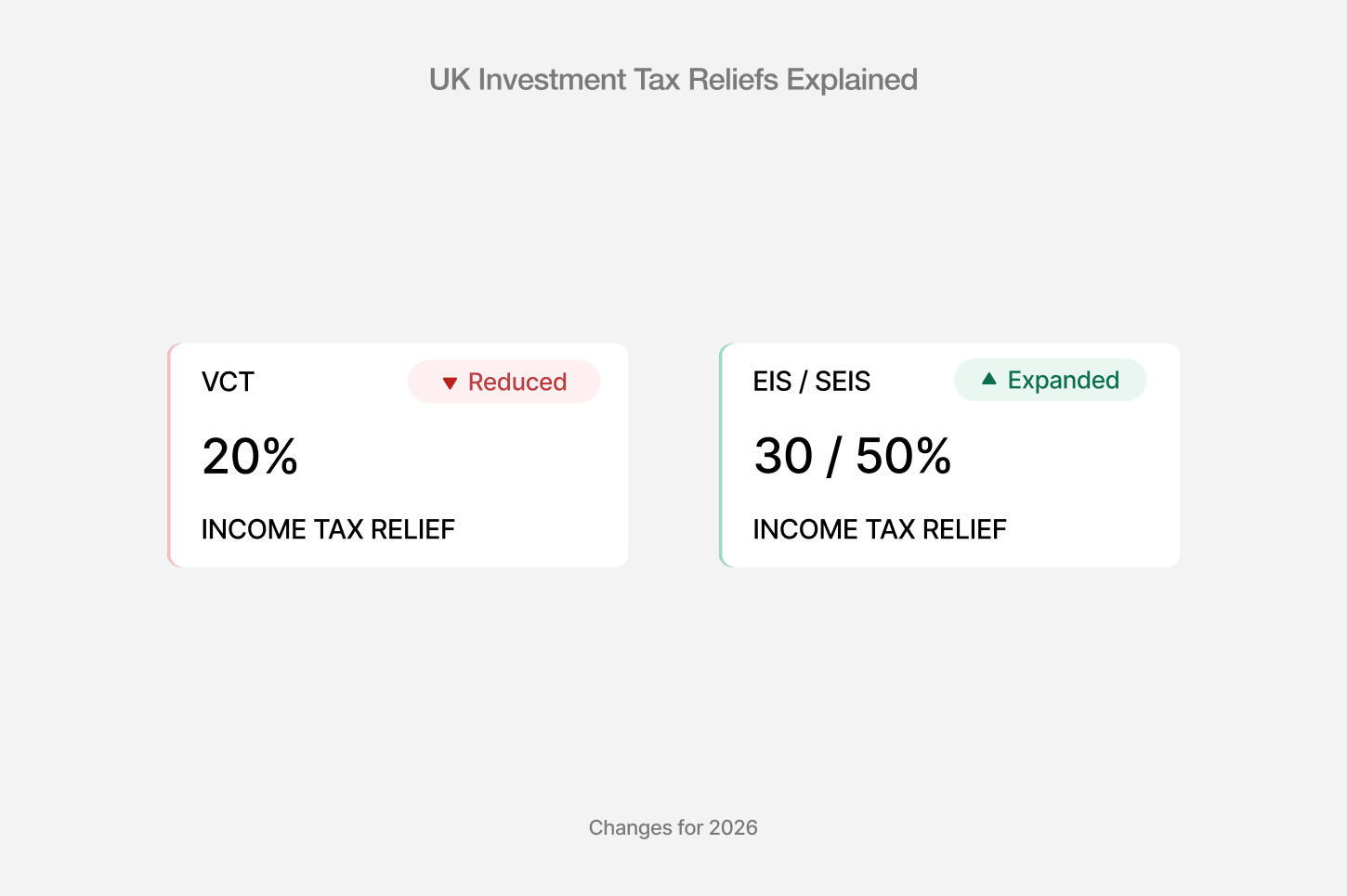
- For shares issued from 6 April 2026, EIS and VCT company limits doubled: £10m a year, £24m lifetime (£20m and £40m for knowledge-intensive companies), and gross assets up to £30m before and £35m after.
- VCT income tax relief fell from 30% to 20%; EIS relief (30%), investor limits, employee limits and all SEIS rules are unchanged.
- Northern Ireland companies trading in goods or electricity keep the old limits; EIS and VCT relief now runs to 2035.
From 6 April 2026 the EIS and VCT company limits doubled: a company can raise £10 million a year and £24 million in total (£20 million and £40 million if knowledge-intensive), with gross assets up to £30 million before and £35 million after the issue. VCT income tax relief fell from 30% to 20%. EIS relief, employee limits and SEIS did not change.
The changes were announced in the Autumn Budget 2025 and set out in HMRC's policy paper. This explainer covers what changed, who it applies to, what stayed the same and what it means for founders raising under EIS and for investors choosing between EIS, SEIS and VCTs.
What changed on 6 April 2026?
Four EIS and VCT company limits doubled and VCT relief was cut by a third. Everything else in the schemes stayed as it was.
| Limit | Before 6 April 2026 | From 6 April 2026 |
|---|---|---|
| Annual amount a company can raise | £5m (£10m knowledge-intensive) | £10m (£20m knowledge-intensive) |
| Lifetime amount a company can raise | £12m (£20m knowledge-intensive) | £24m (£40m knowledge-intensive) |
| Gross assets before the share issue | £15m | £30m |
| Gross assets after the share issue | £16m | £35m |
| VCT income tax relief | 30% | 20% |
| EIS income tax relief | 30% | 30% (unchanged) |
| Employee limit | Fewer than 250 (500 knowledge-intensive) | Unchanged |
| SEIS | £250k company limit, £200k investor limit, 50% relief | Unchanged |
The higher limits apply to shares issued on or after 6 April 2026, so the date of the share issue decides which limits apply, not the date of the advance assurance letter or the term sheet. The same company limits apply to companies receiving VCT investment, because VCTs invest under the same company rules.
Who do the new limits not apply to?
Companies in Northern Ireland that trade in goods, or in generating, transmitting, distributing, supplying or trading electricity, keep the old limits. The policy paper says the increases apply only to qualifying companies outside that group, which remain eligible for the previous limits.
If your company is registered in Northern Ireland, check this before you plan a round above £5 million a year or assets above £15 million.
What did not change
The investor-side rules for EIS and the whole of SEIS are as they were. Most founders raising a first round will notice no difference at all.
- EIS investor relief: 30% income tax relief on up to £1 million a tax year, or £2 million if the amount over £1 million goes into knowledge-intensive companies.
- EIS company tests: fewer than 250 employees (500 knowledge-intensive), usually within seven years of first commercial sale (ten knowledge-intensive), a qualifying trade and the risk-to-capital condition.
- SEIS: £250,000 company limit, £200,000 investor limit, 50% relief, gross assets up to £350,000, fewer than 25 employees and a trade under three years old.
- Holding periods: three years for SEIS and EIS, five years for VCTs.
The schemes also have more time: EIS and VCT relief has been extended to 2035, and SEIS has no end date. For the full company tests, see SEIS/EIS eligibility criteria.
What the changes mean for founders
Scale-ups can stay inside EIS for longer and raise larger rounds with relief. Seed-stage companies are largely unaffected, because the SEIS limits and the order of SEIS and EIS shares are unchanged. Our SEIS/EIS tax relief calculator shows what an investment costs after relief.
- More headroom for later rounds. A company that raised £11 million of EIS and VCT money before April 2026 was close to the old £12 million cap. For shares issued from 6 April 2026 it can raise up to £13 million more, no more than £10 million in any year, if it still meets the age and asset tests.
- Larger balance sheets qualify. A company with £25 million of gross assets was outside EIS before; it can now qualify if the post-issue figure stays at or below £35 million.
- Series A and B under EIS. A £10 million round can now sit entirely under EIS for a standard company with no other risk finance in the previous 12 months, which keeps angels and EIS funds in later rounds.
- Same process. Each new round still needs its own advance assurance application, and the 2026 limits make it worth re-checking companies that HMRC previously said were too large.
For a first round, the structure is the same as before: up to £250,000 under SEIS first, then EIS on a later day. See how to structure a SEIS/EIS round.
The VCT relief cut
New VCT subscriptions from 6 April 2026 get 20% income tax relief instead of 30%, on up to £200,000 a tax year, and the shares must still be held for five years. Tax-free dividends and CGT-free disposals continue.
Example. A £50,000 VCT subscription made in March 2026 earned £15,000 of relief. The same subscription in May 2026 earns £10,000. On the full £200,000 annual limit, relief falls from £60,000 to £40,000. Existing VCT holdings keep the relief they were given.
The government's case is that VCTs already offer tax-free dividends and diversification, so a lower up-front relief is enough. The practical effect is to make EIS relatively more attractive to investors who are comfortable picking individual companies.
EIS, SEIS and VCT compared after April 2026
SEIS still offers the highest relief, EIS the widest range of reliefs and the largest limits, and VCTs diversification and tax-free income at a lower up-front rate.
| SEIS | EIS | VCT | |
|---|---|---|---|
| Income tax relief | 50% | 30% | 20% (was 30%) |
| Investor limit per tax year | £200k | £1m (£2m if the amount over £1m goes into knowledge-intensive companies) | £200k |
| Minimum holding period | 3 years | 3 years | 5 years |
| Gains on the shares | CGT-free after 3 years | CGT-free after 3 years | CGT-free |
| Other gains | 50% of a gain reinvested is exempt | Gains reinvested can be deferred | No deferral |
| Loss relief against income | Yes | Yes | No |
| Dividends | Taxable | Taxable | Tax-free |
| What you buy | Shares in one early-stage company | Shares in one company | Shares in a listed fund holding many companies |
Loss relief example. An additional-rate taxpayer invests £100,000 under EIS and claims £30,000 of income tax relief. If the company fails, the remaining £70,000 loss can be set against income at 45%, worth £31,500. The real loss is £38,500, about 39% of the investment. VCTs do not offer loss relief. For SEIS mechanics, see how SEIS income tax relief works.
CGT deferral. A gain made on another asset can be deferred by reinvesting it in EIS shares from one year before to three years after the disposal (HS297). The deferred gain comes back into charge when the EIS shares are sold.
Inheritance tax: the business relief cap
Separately from the EIS changes, from 6 April 2026 100% business relief for inheritance tax applies to the first £2.5 million of qualifying business and agricultural property, with 50% relief above that (GOV.UK). Unquoted EIS shares held for two years usually qualify for business relief, so investors with large EIS portfolios may want to review estate plans.
Next steps for founders raising under EIS
Check your company against the new limits on the planned issue date, then apply for advance assurance with your investors named. For SEIS and EIS together, one application can cover both. How to apply for SEIS/EIS advance assurance walks through the form, and SEIS vs EIS helps you choose.
Undo Capital's Advance Assurance module drafts the application from your uploaded files and a few questions, and Undo Capital operators with partner lawyers review it and submit it to HMRC. After the round, the platform generates the SEIS1/EIS1 compliance statements so investors can receive their certificates.
FAQs
What changed for EIS in April 2026?

For shares issued from 6 April 2026, a company can raise £10 million a year and £24 million in total under EIS and other risk finance schemes (£20 million and £40 million if knowledge-intensive), with gross assets up to £30 million before and £35 million after the issue. EIS income tax relief stays at 30%.
Did SEIS change in April 2026?
No. SEIS still allows a company to raise £250,000 in total, with gross assets up to £350,000, fewer than 25 employees and a trade under three years old. Investors still get 50% income tax relief on up to £200,000 a tax year, and SEIS shares must still be issued before EIS shares.
Is VCT relief now 20%?
Yes, for new VCT subscriptions from 6 April 2026. Relief is 20% of up to £200,000 a tax year, down from 30%, and the shares must be held for five years. VCT dividends remain tax-free and gains on disposal remain free of capital gains tax. Existing holdings keep the relief already given.
Did the EIS investor limit change?
No. Investors can still claim 30% relief on up to £1 million a tax year, or £2 million if the amount over £1 million goes into knowledge-intensive companies. The doubled limits apply to how much a company can raise and how large it can be, not to how much an individual can invest.
Do the new EIS limits apply in Northern Ireland?
Not to every company. Northern Ireland companies that trade in goods, or in generating, supplying or trading electricity, keep the previous limits: £5 million a year, £12 million lifetime and gross assets of £15 million before and £16 million after the issue. Other Northern Ireland companies use the new limits.
References
- Venture Capital Trusts, Enterprise Investment Scheme investment limit increase and restructure - GOV.UK
- Enterprise Investment Scheme and Venture Capital Trusts scheme extension - GOV.UK
- Tax relief for investors using venture capital schemes - GOV.UK
- Apply to use the Enterprise Investment Scheme to raise money for your company - GOV.UK
- HS297 Capital Gains Tax and Enterprise Investment Scheme - GOV.UK
- Inheritance tax reliefs threshold to rise to £2.5m for farmers and businesses - GOV.UK
Disclosure Notice: This communication is issued by Undo Capital Limited (“Undo Capital”) and is provided strictly for informational purposes only. It contains general information and should not be relied upon as accounting, business, financial, investment, legal, tax, or other professional advice. Undo Capital is not regulated by the Financial Conduct Authority (FCA) and does not provide investment, financial, or tax advice. Our services are designed to assist startups and businesses with company formation, legal agreements, and funding-related documentation. Nothing in this communication constitutes, or should be construed as, a recommendation, offer, or solicitation to purchase or sell any security or financial instrument.
Participation in startups and early-stage enterprises involves significant risk. Such investments may be illiquid, may not generate dividends, may be subject to dilution, and may result in the total loss of invested capital. Any decisions or actions that may affect your business or personal interests should be taken only after seeking advice from suitably qualified professional advisors, and should form part of a balanced and diversified portfolio. This communication may contain links to third-party websites. The inclusion of such links does not imply endorsement, approval, investigation, or verification by Undo Capital. We accept no responsibility or liability for the content, accuracy, or use of information contained on any third-party websites.
Latest articles

SEIS and EIS tax relief calculator
Founders agreement template UK: what every co-founder should include