How to Set Up a Virtual Data Room for Startup Fundraising (2026 Guide)



- The problem it fixes: Investors ask for documents fast. Scattered email attachments and a public Drive folder make you look unprepared and slow your raise.
- What it is: A data room for startups is a secure, access-controlled space holding your cap table, financials, legal papers, and deck in one place.
- The mistake to avoid: Founders build the data room mid-raise, in a panic. Build it early, keep it current, and track who opens what.
Here is the short version. To set up a data room for investors, you build a structured set of folders, fill them with clean and current documents, control who can see what, and share one secure link. Do this before you start pitching, not during. A messy or missing data room is one of the easiest ways to lose momentum in a raise.
This guide shows you how, step by step, for UK founders going from pre-seed to Series A.
What is a data room for startups?
A data room for startups is a secure online space where founders store and share the documents investors need during fundraising or due diligence. It holds your cap table, financials, legal documents, and pitch materials in one organised, access-controlled location. It replaces scattered attachments with a single, professional source of truth.
The term comes from old M&A practice. Buyers once reviewed sensitive papers in a physical, locked room. The virtual data room is the digital version. For startups, it is now a standard kit for any serious raise.
Think of it as the difference between handing someone a tidy binder and pointing them at a pile of paper on a desk. Same information. Very different impression.
Virtual data room vs a shared Drive folder
People often ask why a Google Drive folder will not work. It can, at the very earliest stage. But a shared folder gives you basic storage and little else.
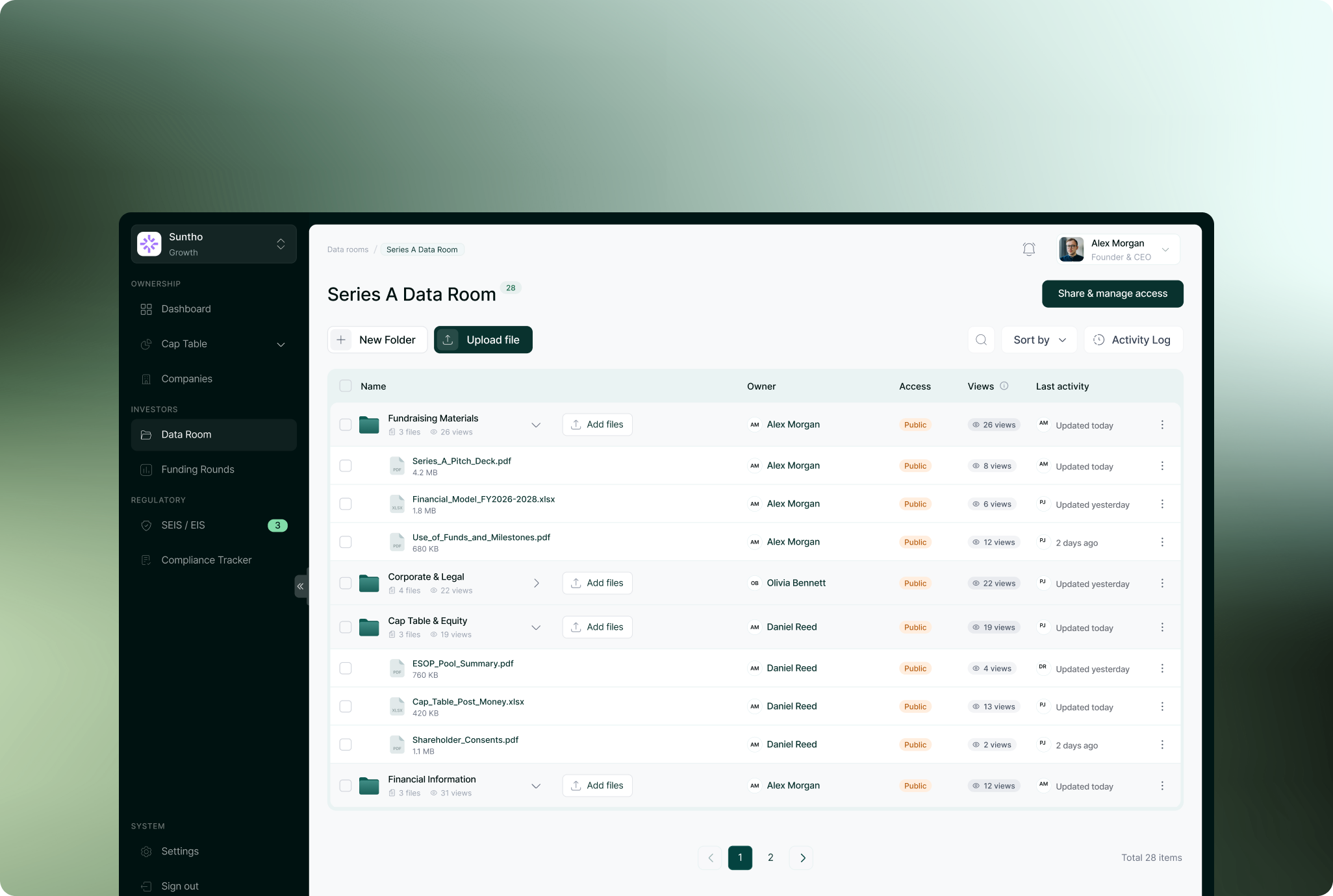
A virtual data room adds granular access control, document-level permissions, view tracking, and audit trails. That matters during a raise. You can see which investor opened your financials and when. You can revoke access if a deal stalls. You can stop one investor from seeing another’s terms.
Modern fundraising requires more than secure document storage. The best virtual data room software helps founders manage the entire investor due diligence process while keeping sensitive information organised and under control. When you compare a virtual data room against a folder on those terms, the gap is obvious.
With the Undo Capital Investor Data Room, founders can:
- Create secure investor links with custom permissions.
- Track who viewed or downloaded each document.
- Invite investors and advisers with role-based access.
- Organise documents using a professional fundraising folder structure.
- Use ready-made fundraising and due diligence templates.
- Manage funding rounds, cap table updates and investor documents from a single platform.
Instead of switching between Google Drive, email, spreadsheets and multiple legal tools, everything stays connected in one place. As your fundraising progresses from pre-seed to Series A, your investor data room grows with it, making due diligence faster for both founders and investors.
Why investors expect a data room during fundraising
Venture investors review hundreds of startup opportunities every year. After an initial conversation or a review of your pitch deck, they often request access to an investor data room to better understand your business before deciding whether to progress.
A well-organised virtual data room provides investors with immediate access to your financial model, cap table, legal documents, customer traction, and other key materials in one secure location. Instead of sending multiple email attachments or managing several cloud folders, founders can share a single link, keep documents current, and streamline the fundraising process.
As discussions progress, the data room serves as the central workspace for investor due diligence, legal review, and final transaction documents. For founders, it provides a single organised source of truth, reduces administrative work, and maintains clarity from the initial meeting to closing the round.
When do you need a data room? (pre-seed to Series A)
The honest answer: as soon as you start talking to investors seriously. But the depth scales with your stage. A pre-seed room is lean. A Series A data room is far more detailed.
Below is how the contents change as you grow.
Pre-seed and seed: keep it lean
At pre-seed, you usually need only a lightweight room. A tidy set of core documents does the job: the deck, a simple cap table, basic financials, and incorporation papers.
Do not overbuild here. A 40-folder structure at pre-seed looks like theatre. Investors at this stage back the founder and the idea more than the paperwork. Keep it clean and current.
Data room fundraising at this stage is about removing friction, not showing off. If an angel asks for your numbers, you want to send one link, not dig through your inbox.
Series A data room: what changes
A Series A data room requires a much more comprehensive approach. By now, you have real revenue, a team, contracts, and a more complex cap table. Due diligence gets thorough.
Expect investors to want historical and projected financials, key metrics, customer and supplier contracts, IP records, and detailed legal files. The room grows folders. This is also where data room venture capital norms apply: VC firms have checklists, and they will work through them.
Building this VC data room properly takes time. Start a month before you plan to raise, not the week you send your first email.
What to include in your investor data room
This is the part most founders search for. Here is a folder-by-folder structure you can copy. It scales: use the lean column at pre-seed, the full column by Series A.
This data rooms for investors checklist is deliberately plain. Investors do not want clever. They want to find it.
Company and corporate documents
Start here. Your certificate of incorporation, articles of association, and shareholder register belong in this folder. Add board minutes once you have a board.
These are the documents that prove the company is real and properly run. They are also the ones founders most often lose track of after a couple of years. Find them now.
Cap table, SEIS/EIS and shareholder records
Your cap table is the document investors scrutinise hardest. It must reconcile to the penny. Show who owns what, the option pool, and any convertibles.
UK founders should also include SEIS/EIS Advance Assurance. The Seed Enterprise Investment Scheme and Enterprise Investment Scheme give UK investors generous tax relief, and HMRC sets the rules. SEIS Advance Assurance is often the first thing a UK angel asks for. Having it ready in the room removes a common delay.
Financials, metrics and the pitch
Put your historical accounts, management accounts, and financial model here. Add a clear set of metrics: revenue, growth, retention, burn, and runway.
Then the pitch deck. Yes, investors already have it. Put it in anyway, so the room tells the whole story on its own.
Legal, IP and contracts
By Series A, this section earns its place. Key contracts, employment agreements, IP assignments, and GDPR documentation all go here.
A frequent gap: founders forget IP assignment agreements from early contractors. If a freelancer built your first product and never signed over the IP, an investor will find it. Fix that before they look.
How to set up a data room for investors, step by step
Now the core question: how to set up a data room for investors. The process is simple if you do it in order. Most pain comes from doing it backwards, mid-raise.
Here are the steps.
Step 1: Structure your folders before you upload
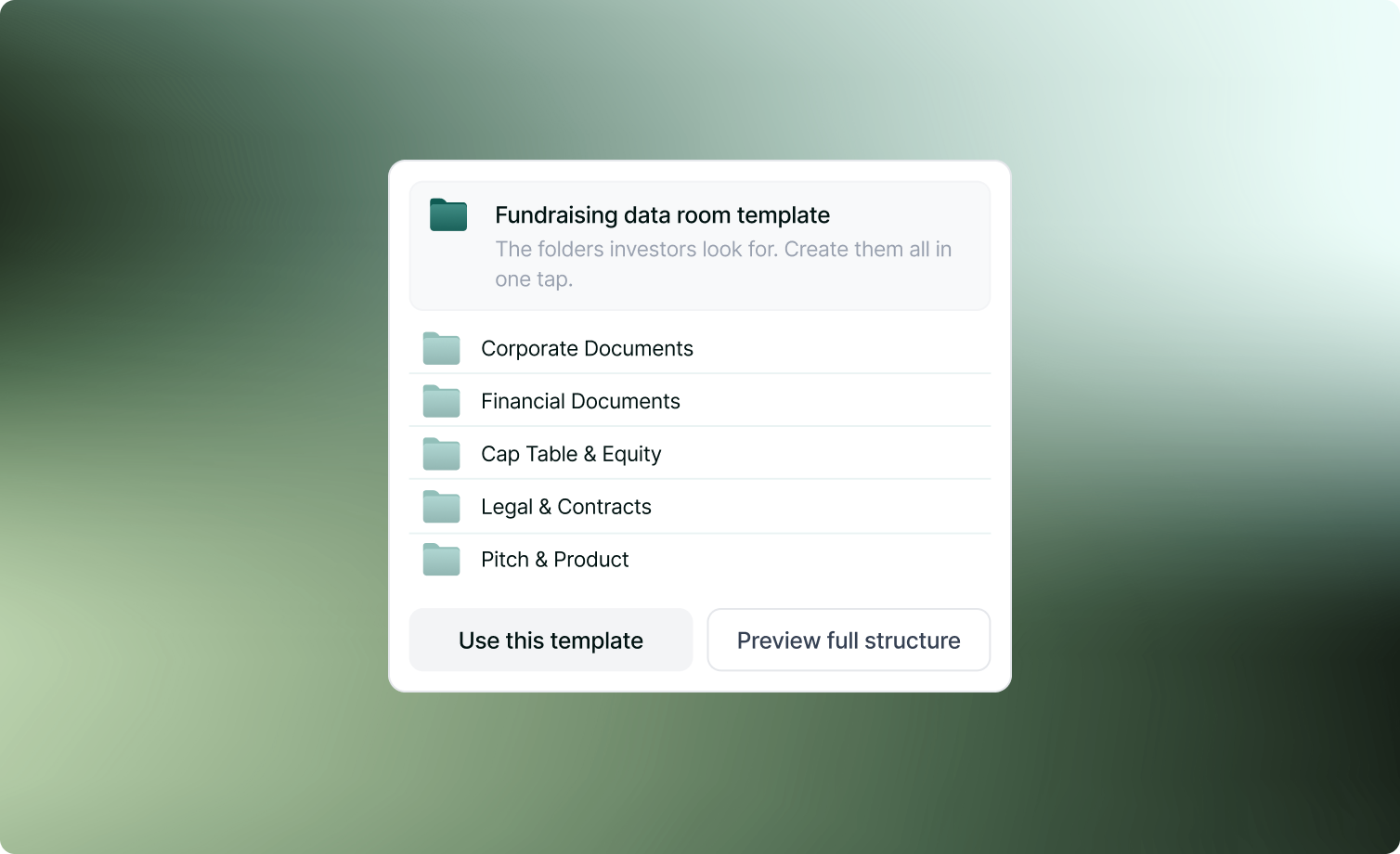
Build the empty folder structure first, using the table above. Name folders clearly and number them so they sort in a logical order.
This sounds obvious. It is the step founders skip. They start dumping files in, then spend an afternoon reorganising. Build the shelves before you stock them.
If you want to save time, you can start with Undo Capital’s investor data room templates, which come with a fundraising-ready folder structure based on what investors typically expect to see. You can customise the structure at any time as your company grows.
Create your free account and start building your investor data room
Step 2: Control access and permissions
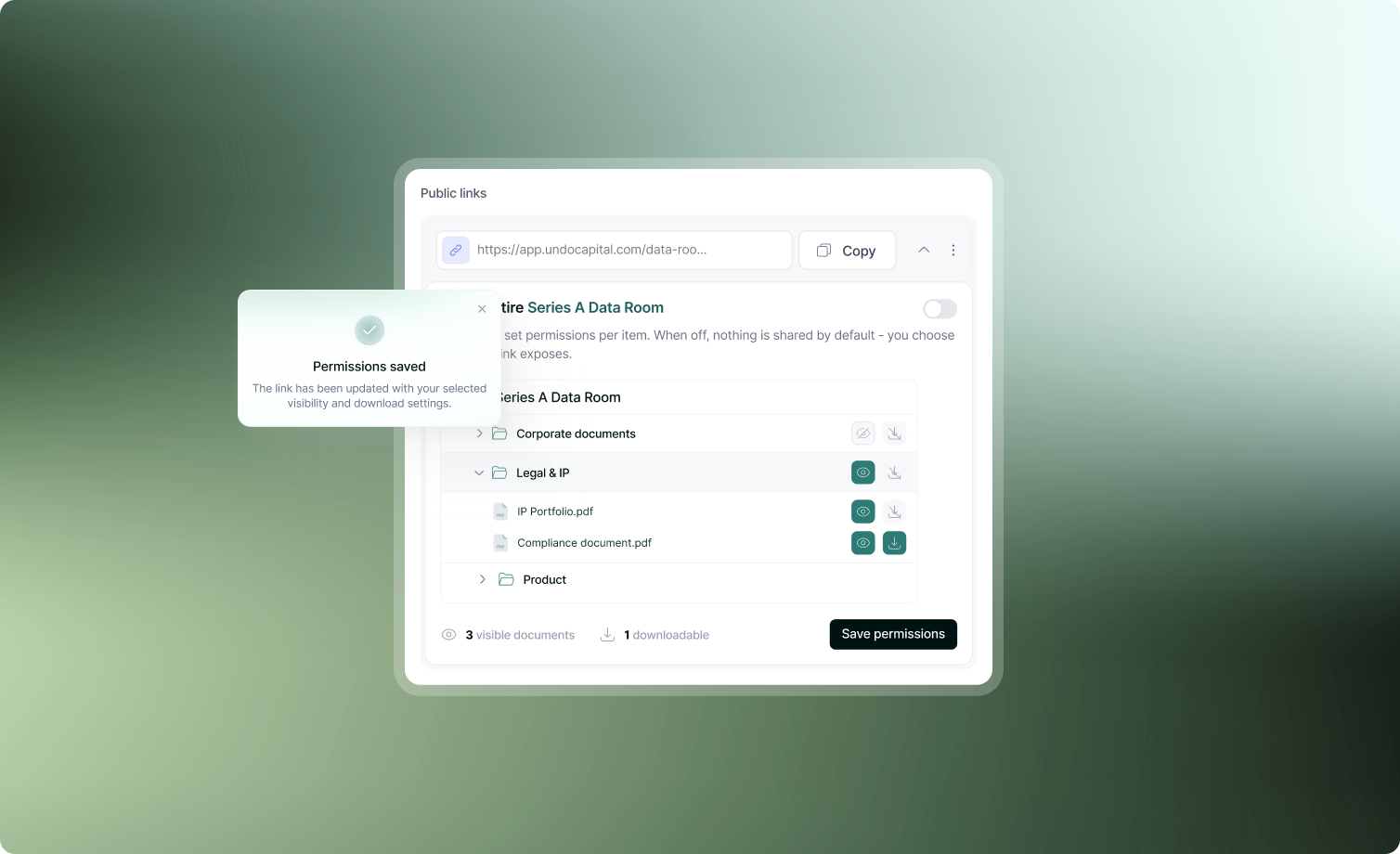
Now set who sees what. This is where a real room beats a folder. Give each investor view access. Restrict downloads on your most sensitive files, like detailed financials, until a deal is serious.
Set document-level permissions so a casual browser sees the deck and headline numbers, while an investor in active diligence sees everything. Knowing how to set up a data room for investors well is mostly knowing how to stage this access.
Step 3: Upload clean, current documents and share one link
Upload your documents. Check that each one is the latest version. Delete drafts. Then generate a single secure link and share that, rather than emailing files one by one.
One link. One source of truth. If a document changes, you update it in the room, and every investor sees the current version.
Step 4: Track engagement and keep it updated
Watch the analytics. A good room shows you which investor viewed what, and for how long. If a lead spent ten minutes on your financial model, that is a strong signal. Follow up while it is warm.
Then keep the room current through the raise. Update metrics monthly. A stale room undoes all the work of building a tidy one.
Best practices for evaluating a virtual data room for fundraising
Once you decide to use a dedicated tool, you need to pick one. The brief here is short: security, tracking, and ease of sharing. These are the best practices for evaluating virtual data rooms for fundraising.
There are many data room software for investors on the market, and a quick virtual data room comparison shows prices ranging from free tiers to enterprise plans costing hundreds of pounds a month. For a startup raise, you do not need the heavyweight M&A platforms. You need something secure, simple, and built for founders.
What to look for (security, tracking, ease of sharing)
Look for three things:
- Security: granular permissions, audit trails, and the ability to revoke access.
- Tracking: view and download analytics per investor.
- Ease of sharing: one clean link, no clunky logins that annoy busy partners.
Some founders use data room creation services to outsource the build, but for most UK startups, that is overkill. The structure in this guide is enough to do it yourself.
If you want a room built for UK fundraising rather than corporate M&A, a purpose-built virtual data room for startups from a founder-focused platform is the simplest path. Tools like the data room for startups inside Undo Capital keep your room, cap table, and SEIS/EIS records in one place, which removes the version-control mess of separate systems.
Common data room mistakes founders make
A few errors come up again and again.
- Building it during the raise. The worst one. You get a term sheet, then scramble. Build the room before you pitch.
- An out-of-date cap table. If the room version does not match reality, trust drops fast. Reconcile it.
- Too much, too early. A pre-seed room with 50 folders signals confusion, not diligence. Match depth to stage.
- No access control. Sharing an open link defeats the point. Set permissions.
- Letting it go stale. Metrics from three months ago make you look asleep. Update monthly.
Set up your raise and data room in one place
A good data room will not win a raise on its own. But a bad one can slow it, and a missing one can stall it. The founders who raise the fastest are the ones who treat the room as part of the pitch, not an afterthought.
Your next step is simple: build the empty folder structure from the table above this week, before you talk to a single investor. Then fill it, set permissions, and keep it current.
If you would rather keep your data room, cap table, and SEIS/EIS records in one connected place, you can explore Undo Capital's data room for startups and book a walkthrough.
Note: This article is general information, not financial, investment or legal advice. Verify any tax-relief details with HMRC or a qualified adviser before relying on them.
FAQs
What is a data room for startups?

A data room for startups is a secure online space where founders store and share the documents investors need during fundraising or due diligence. It typically holds your cap table, financials, legal documents, and pitch materials in one organised, access-controlled location, replacing scattered email attachments and shared folders with a single professional source of truth.
How do you set up a data room for investors?
You set up a data room by first structuring your folders (corporate, financials, cap table, legal, product), uploading clean and current documents, setting view and download permissions for each investor, and then sharing a single secure link. The best setups also let you track which investors viewed what, so you can follow up at the right moment.
What should a startup include in its fundraising data room?
A fundraising data room should include corporate documents (incorporation, articles, shareholder register), the cap table, SEIS/EIS Advance Assurance, historical and projected financials, key metrics, the pitch deck, customer and supplier contracts, and IP records. The exact contents scale with your stage, with a Series A data room being far more detailed than a pre-seed one.
Do I need a data room at pre-seed?
Yes. Every startup raising investment should have an investor data room from day one. At the pre-seed stage, it can be simple, containing your pitch deck, cap table, financial model and core company documents, but having everything organised in one secure place makes it easier to share information with investors and scale your fundraising as your company grows.
What's the difference between a data room and a shared Drive folder?
A shared Drive folder offers basic storage, but a virtual data room adds granular access control, document-level permissions, view tracking, and audit trails. For fundraising, those features matter: they keep sensitive information secure, show you who is engaging, and present your startup more professionally to investors.
References
Disclosure Notice: This communication is issued by Undo Capital Limited (“Undo Capital”) and is provided strictly for informational purposes only. It contains general information and should not be relied upon as accounting, business, financial, investment, legal, tax, or other professional advice. Undo Capital is not regulated by the Financial Conduct Authority (FCA) and does not provide investment, financial, or tax advice. Our services are designed to assist startups and businesses with company formation, legal agreements, and funding-related documentation. Nothing in this communication constitutes, or should be construed as, a recommendation, offer, or solicitation to purchase or sell any security or financial instrument.
Participation in startups and early-stage enterprises involves significant risk. Such investments may be illiquid, may not generate dividends, may be subject to dilution, and may result in the total loss of invested capital. Any decisions or actions that may affect your business or personal interests should be taken only after seeking advice from suitably qualified professional advisors, and should form part of a balanced and diversified portfolio. This communication may contain links to third-party websites. The inclusion of such links does not imply endorsement, approval, investigation, or verification by Undo Capital. We accept no responsibility or liability for the content, accuracy, or use of information contained on any third-party websites.
Latest articles

SEIS and EIS Tax Relief Calculator
Founders Agreement Template UK: What Every Co-Founder Should Include